









Sacrament to Statute:
MARRIAGES JOURNEY FROM CLANS TO SAME-SEX UNIONS
- Atilla Tiriyaki
- Average Reading Time: 19 minutes
- Community
- articles, atillat, guides
Marriage, for many, is an essential part of the life experience, forming the bedrock of their faith, representing a deep level of commitment, and symbolising their union to the world. Over the centuries, the concept of marriage and unions has shifted from something that was once more a personal commitment to now something performed in a more faith-based setting, with people making a public declaration before friends, family, and God. Traditionally, marriage was only seen as a union between a man and a woman; however, as more countries globally recognise same-sex marriage and many major denominations slowly change their positions, let us explore the history of marriage, what it looks like today, and what it might look like in the future.
DISCLAIMER
All published articles are intended for an audience aged 18 years and over and have been written by members of the general public. Many will likely not be journalists nor be affiliated with any professional bodies associated with members of the media. The articles will likely be based on the authors' own opinions, views, and experiences...more
Marriage, for many, represents the deep connection and the coming together of people, the joining of families, and the creation of a, hopefully, long and happy union. It is a concept and institution that has been around and inspired so many to make a public display of commitment for thousands of years, driven not only by the human instinct to procreate and create life, but also to form meaningful connections, to love, to be loved and ultimately to share their lives with someone special.
Marriages and unions have been formed for thousands of years and have been of significant importance in nearly all cultures, societies, and religions throughout the centuries. In the modern era, the definition of what they represent, and ultimately who should be able to form them, has long been debated. With some believing marriage should be a right for all, while others, more traditionalists and religious hardliners, make their position clear, that they believe that a recognised and legitimate marriage can only take place between a man and a woman, performed in a faith setting and be recognised by God and the state.
When it comes to marriage, the debate over equality is not only about forming unions in accordance with one’s faith and beliefs, but, more importantly, about the legal recognition and rights that come with it. Rights such as the transfer of assets upon a spouse’s death, decision-making at critical points in a person’s life (e.g., end-of-life), tax treatment, and broader legal rights. Around the world today, 33.5% or 78 out of 233 countries and territories recognise same-sex marriages, unions or partnerships, and just 27% or 64 countries recognise traditionally defined marriages for same-sex couples.
With those calling for marriage equality and those holding firm to the traditional definition of marriage, let us explore the origins of marriage, how it was traditionally formed, and how it has evolved over the centuries.
Marriages and unions have been formed for thousands of years and have been of significant importance in nearly all cultures, societies, and religions throughout the centuries. In the modern era, the definition of what they represent, and ultimately who should be able to form them, has long been debated. With some believing marriage should be a right for all, while others, more traditionalists and religious hardliners, make their position clear, that they believe that a recognised and legitimate marriage can only take place between a man and a woman, performed in a faith setting and be recognised by God and the state.
When it comes to marriage, the debate over equality is not only about forming unions in accordance with one’s faith and beliefs, but, more importantly, about the legal recognition and rights that come with it. Rights such as the transfer of assets upon a spouse’s death, decision-making at critical points in a person’s life (e.g., end-of-life), tax treatment, and broader legal rights. Around the world today, 33.5% or 78 out of 233 countries and territories recognise same-sex marriages, unions or partnerships, and just 27% or 64 countries recognise traditionally defined marriages for same-sex couples.
With those calling for marriage equality and those holding firm to the traditional definition of marriage, let us explore the origins of marriage, how it was traditionally formed, and how it has evolved over the centuries.
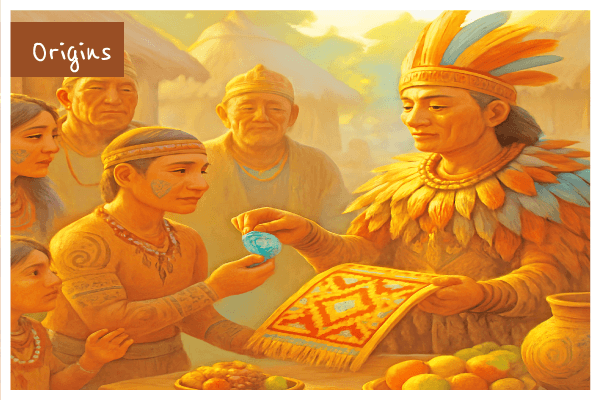
Many historians and archaeologists over the years have publicly stated that various forms of marriage have existed for at least 4,350 years, with the earliest recorded marriage believed to have occurred around 2,350 BC in ancient Mesopotamia. Though many believe that the concept of marriages and unions predate that period, some anthropologists, through their research and findings, believe families, historically, often consisted of groups of around 30 people and that men within the group would operate in a hierarchy, like a pride, with a dominant or alpha male leading the group.
Marriage became much more popular throughout ancient Hebrew, Greek and Roman civilisations; however, the concept of marriage was very different from how we define it today. An ancient Babylonian law, known as Hammurabi’s Code, from around 1790 BC, contains some of the oldest recorded marriage laws. In the Babylonian text, marriage is primarily defined as a contract to protect women, yet it also includes rules that restricted women’s rights. A man could divorce his wife if she were unable to bear him children, as well as if she humiliated him in public, or neglected the house and her duties, and severe punishment was handed down if she committed adultery.
Though some societies had laws, many were less formal. In the ancient world, it was seen as very different from the institution of marriage we know today, with marriage being known as affectio maritalis in Rome and gamos in Greek. Marriage in ancient Rome was primarily seen as a personal agreement between the bride and the groom, likely with little to no legal or state recognition, more of a commitment to live together and start a family. Even the kiss found at the end of many modern wedding ceremonies has its origins in ancient Rome. The act and term “sealed with a kiss” represented the legal bond that bound the marriage contract.
Even though marriage may not have had the same legal weight as it does today, it was still seen as necessary and critical for a functioning society. For example, in Ancient Greece, the Athenian statesman, lawmaker and philosopher Solon, born around 630 BC, once considered making marriage compulsory in Athens. In other periods of Ancient Greece, unmarried men could not hold certain public positions, and in Sparta, childless and unmarried men were treated with contempt. The Roman Emperor Augustus, born in 63 BC, passed drastic laws in Ancient Rome, forcing people to marry and imposing penalties and hardships on those who did not.
Even the word “marriage” did not always exist and is relatively new compared to the ceremony itself, a word that has evolved over the centuries and is believed to have derived from the Latin word maritātus and the old French word maritāre, all representing what we know as the term marriage, used since the 13th century CE. Many of the ancient words, variations, and terms we associate with the ceremony itself often provide clues to the basis, motivations, and reasoning behind some of the early unions.
Historically, marriage might have been seen as an exchange, an arrangement that benefits some or all of those involved, a concept that still occurs in some traditions and cultures in parts of the world today. Whether it was Kings marrying off their daughters to secure political alliances or a farmer gaining cattle or money in the form of a dowry for the hand in marriage of their child, for many throughout time, marriage was seen as strategic. Though love and commitment between those married off may have existed or evolved in time, many marriages and unions were strategic, sometimes commercial, with the aim of betterment and securing a long and successful lineage.
When it comes to faith and marriage, in reality, the show of commitment predates many of the major denominations and religions that exist today. Though in ancient times people may have made offerings to deities and asked for blessings from shamans and spiritual leaders, it would likely be very different from the marriage rituals performed today.
Though many ancient world marriages and unions were formed, they were often done so informally or through personal commitments, as many were not legally recorded or officially captured by those in power at the time. During a period where there was no separation of church and state in many countries around the world, churches and faith leaders were often the keepers of marriage and union records, especially for those they personally officiated at.
Marriage became much more popular throughout ancient Hebrew, Greek and Roman civilisations; however, the concept of marriage was very different from how we define it today. An ancient Babylonian law, known as Hammurabi’s Code, from around 1790 BC, contains some of the oldest recorded marriage laws. In the Babylonian text, marriage is primarily defined as a contract to protect women, yet it also includes rules that restricted women’s rights. A man could divorce his wife if she were unable to bear him children, as well as if she humiliated him in public, or neglected the house and her duties, and severe punishment was handed down if she committed adultery.
Though some societies had laws, many were less formal. In the ancient world, it was seen as very different from the institution of marriage we know today, with marriage being known as affectio maritalis in Rome and gamos in Greek. Marriage in ancient Rome was primarily seen as a personal agreement between the bride and the groom, likely with little to no legal or state recognition, more of a commitment to live together and start a family. Even the kiss found at the end of many modern wedding ceremonies has its origins in ancient Rome. The act and term “sealed with a kiss” represented the legal bond that bound the marriage contract.
Even though marriage may not have had the same legal weight as it does today, it was still seen as necessary and critical for a functioning society. For example, in Ancient Greece, the Athenian statesman, lawmaker and philosopher Solon, born around 630 BC, once considered making marriage compulsory in Athens. In other periods of Ancient Greece, unmarried men could not hold certain public positions, and in Sparta, childless and unmarried men were treated with contempt. The Roman Emperor Augustus, born in 63 BC, passed drastic laws in Ancient Rome, forcing people to marry and imposing penalties and hardships on those who did not.
Even the word “marriage” did not always exist and is relatively new compared to the ceremony itself, a word that has evolved over the centuries and is believed to have derived from the Latin word maritātus and the old French word maritāre, all representing what we know as the term marriage, used since the 13th century CE. Many of the ancient words, variations, and terms we associate with the ceremony itself often provide clues to the basis, motivations, and reasoning behind some of the early unions.
Historically, marriage might have been seen as an exchange, an arrangement that benefits some or all of those involved, a concept that still occurs in some traditions and cultures in parts of the world today. Whether it was Kings marrying off their daughters to secure political alliances or a farmer gaining cattle or money in the form of a dowry for the hand in marriage of their child, for many throughout time, marriage was seen as strategic. Though love and commitment between those married off may have existed or evolved in time, many marriages and unions were strategic, sometimes commercial, with the aim of betterment and securing a long and successful lineage.
When it comes to faith and marriage, in reality, the show of commitment predates many of the major denominations and religions that exist today. Though in ancient times people may have made offerings to deities and asked for blessings from shamans and spiritual leaders, it would likely be very different from the marriage rituals performed today.
Though many ancient world marriages and unions were formed, they were often done so informally or through personal commitments, as many were not legally recorded or officially captured by those in power at the time. During a period where there was no separation of church and state in many countries around the world, churches and faith leaders were often the keepers of marriage and union records, especially for those they personally officiated at.
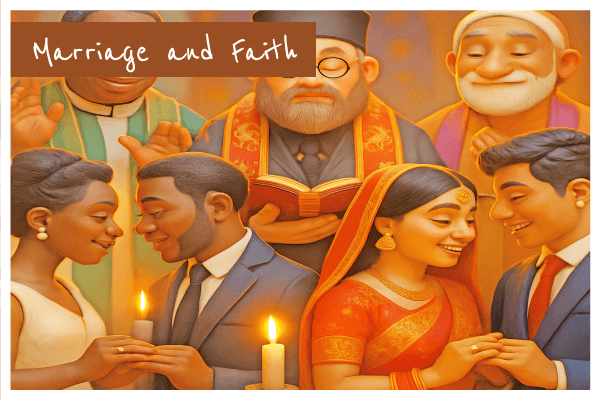
The institution and sanctity of marriage have become the bedrock and a principal foundation of the many faiths and religions that exist today. A marriage union has come to mean not only a personal commitment to each other in front of God, their friends, family and community; however, it is also a commitment to a person’s faith, one that they will pass down to their children and how they will live their lives together going forward. Even interfaith marriages, or marriages between individuals of different religions, are permitted when one partner converts to or adopts the other partner’s faith.
Marriage and its meaning have evolved and been defined over the centuries, with ceremonies and traditions that have endured; however, this was not always the case. In Christianity, the belief and idea that marriage is one of the seven sacraments does not come from the bible, as the bible does not provide a formal definition of marriage, or of the union, as within the bible it does not refer to marriage, but instead references the action of men, such as taking, lying with or going to women. The concepts of modern marriage and the sacrament are believed to have evolved from the Middle Ages, according to the teaching of Saint Augustine, also known as Augustine of Hippo, a Christian theologian and philosopher born in 354 AD in Roman Africa.
Due to this change in approach and following the teachings of Saint Augustine, many religious rituals did not take place until the later part of the Middle Ages, from the 11th to 12th centuries, when ritual and marriage vows began to be performed in churches. In the Roman Catholic Church, it was not until November 11, 1563, during the twenty-fourth session of the Council of Trent, the ecumenical council, that the church decreed the sacramental nature of marriage.
In many of the countries or regions considered Islamic today, various types of marriage were recognised, including marriage by agreement, marriage by capture, marriage by mahr (or dowry), marriage by inheritance, and a temporary marriage known as Mut’ah (mot’a), which is a private, verbal Islamic marriage contract allowing a man and woman to marry for a specified, limited time, with pre-agreed dower and duration. With the broader adoption of Islam across the region and the introduction of Sharia and Islamic law, marriage contracts or nihahs changed and became primarily based on the bride’s acceptance, the groom’s dower, as well as witnesses to the union. Other traditional steps were introduced, such as preliminarily meetings, the marriage feast and the sending off of the bride and groom. Islam also permits polygamy or the ability for a man to take multiple wives; however, there are rules surrounding the circumstances and conditions under which these unions can be formed.
In Islam, the Qur’an addresses marriage in several of the 114 surahs (chapters); however, the specifics are often open to theological and scholastic interpretation. Modern-day Islamic law, or Sharia, is derived from the teachings of the Qur’an and the Hadith, based on the Prophet Muhammad and his immediate circle, the companions. The Hadith text provides a broader interpretation of marriage from the Prophet and his companions, the Sahabah and Ahl al Bayt. The Sahabah, the companions of Muhammad, follow an understanding of his teachings that forms modern-day Sunni Islam, and the Ahl al-Bayt, the descendants of the Prophet Muhammad, follow another interpretation of his teachings that forms modern-day Shia Islam.
Like the Bible, the Torah mentions no wedding ceremony; however, the institution of marriage is seen as having a divine origin, beginning with the first man and woman, Adam and Eve. In the Hebrew Bible and Torah, other examples of marriage are referenced, such as those of Isaac, Jacob, and Samson. So is the act of Polygyny, or men having multiple wives at once, which is most commonly referenced as a marital arrangement, as well as concubinage, where an unmarried couple may have the same rights as a recognised spouse, in certain circumstances, such as during war.
The first instance of marital love is referenced is in Genesis 24:67, which reads, “Isaac loved her,” referring to his love for his wife, Rebekah. The interpretation of relationships like Adam and Eve and Isaac and Rebekah laid the foundation for marriage in Judaism. Marriage is considered a sacred covenant established by God, emphasising family, procreation, and social stability. The Hebrew word for marriage, kiddushin, is derived from the word kadosh, meaning “sacred” or “holy.” Many of the customs, such as arranged marriages, compensation or dowry, and any special pre-marriage conditions, reflect practices that existed during biblical times.
In non-Abrahamic religions and faiths, in Buddhism, it is believed that Buddha never spoke for or against marriage; instead, highlighting the difficulties that many married people face. Buddhism has a long tradition of monastic celibacy; however, most Buddhists live in couples or families, married or unmarried. Buddhism emphasises the circle of life and procreation, and, with no creator or God that requires or blesses unions, it was often seen more as a legal or declaration of commitment rather than a religious obligation. Today, many modern Buddhists view marriage as a significant part of their social and spiritual life, with Buddhists emphasising the quality of the relationship and the desire not to cause harm to others.
In Hinduism, marriage has long been seen as a sacramental union, and the Dharmasutras, dating back to as early as 600 BC, describe eight forms of marriage: Brahma, Daiva, Arsa, Prajapatya, Asura, Gandharva, Raksasa, and Paisaca. The first Brahma relates to an arranged marriage from a good family; the second Daiva relates to seeking and forming a union while a priest conducts a sacrificial ceremony.
Arsa refers to a marriage in which goods, items, or livestock are exchanged as a dowry for a bride, and Prajapatya refers to marriages in which the bride is of childbearing age and seeking marriage. Asura refers to a non-traditional match in which money is exchanged to form the union, while a marriage formed from love is known as Gandharva. More historical and aggressive, the union where the groom, possibly with the consent of the bride, overcomes the bride’s family and carries her away is known as Raksasa, and the final is similar to Raksasa, but where the bride may not give consent and where the groom takes her away is known as Paisaca. Of the eight forms, historically and typically, many modern Hindu marriages are performed in the Brahma or Gandharva form.
Across faiths and religions, there has been an evolution in marriage, from traditional rituals or where none at all existed, to a time, today, where many marriages are carried out in a faith settings, in a place of worship, performed by a spiritual leader, where distinct rituals and ceremonies are performed and where the law, not only provides legal recognition, but also benefits and protections within the law for those that are married. The separation between church and state has meant that many people around the world today are able to choose, to choose who they love, whether to marry, who to marry and ultimately whether to have a religious ceremony or not; however, some countries are still failing or not willing to recognise same-sex marriage rights, citing traditional or family values. An argument and position that actually has no real basis, as it does not and would not stack up throughout the majority of human history, for thousands of years, from early human life to just 500 or 600 years ago, and only then as a theological change in position and status.
Marriage and its meaning have evolved and been defined over the centuries, with ceremonies and traditions that have endured; however, this was not always the case. In Christianity, the belief and idea that marriage is one of the seven sacraments does not come from the bible, as the bible does not provide a formal definition of marriage, or of the union, as within the bible it does not refer to marriage, but instead references the action of men, such as taking, lying with or going to women. The concepts of modern marriage and the sacrament are believed to have evolved from the Middle Ages, according to the teaching of Saint Augustine, also known as Augustine of Hippo, a Christian theologian and philosopher born in 354 AD in Roman Africa.
Due to this change in approach and following the teachings of Saint Augustine, many religious rituals did not take place until the later part of the Middle Ages, from the 11th to 12th centuries, when ritual and marriage vows began to be performed in churches. In the Roman Catholic Church, it was not until November 11, 1563, during the twenty-fourth session of the Council of Trent, the ecumenical council, that the church decreed the sacramental nature of marriage.
In many of the countries or regions considered Islamic today, various types of marriage were recognised, including marriage by agreement, marriage by capture, marriage by mahr (or dowry), marriage by inheritance, and a temporary marriage known as Mut’ah (mot’a), which is a private, verbal Islamic marriage contract allowing a man and woman to marry for a specified, limited time, with pre-agreed dower and duration. With the broader adoption of Islam across the region and the introduction of Sharia and Islamic law, marriage contracts or nihahs changed and became primarily based on the bride’s acceptance, the groom’s dower, as well as witnesses to the union. Other traditional steps were introduced, such as preliminarily meetings, the marriage feast and the sending off of the bride and groom. Islam also permits polygamy or the ability for a man to take multiple wives; however, there are rules surrounding the circumstances and conditions under which these unions can be formed.
In Islam, the Qur’an addresses marriage in several of the 114 surahs (chapters); however, the specifics are often open to theological and scholastic interpretation. Modern-day Islamic law, or Sharia, is derived from the teachings of the Qur’an and the Hadith, based on the Prophet Muhammad and his immediate circle, the companions. The Hadith text provides a broader interpretation of marriage from the Prophet and his companions, the Sahabah and Ahl al Bayt. The Sahabah, the companions of Muhammad, follow an understanding of his teachings that forms modern-day Sunni Islam, and the Ahl al-Bayt, the descendants of the Prophet Muhammad, follow another interpretation of his teachings that forms modern-day Shia Islam.
Like the Bible, the Torah mentions no wedding ceremony; however, the institution of marriage is seen as having a divine origin, beginning with the first man and woman, Adam and Eve. In the Hebrew Bible and Torah, other examples of marriage are referenced, such as those of Isaac, Jacob, and Samson. So is the act of Polygyny, or men having multiple wives at once, which is most commonly referenced as a marital arrangement, as well as concubinage, where an unmarried couple may have the same rights as a recognised spouse, in certain circumstances, such as during war.
The first instance of marital love is referenced is in Genesis 24:67, which reads, “Isaac loved her,” referring to his love for his wife, Rebekah. The interpretation of relationships like Adam and Eve and Isaac and Rebekah laid the foundation for marriage in Judaism. Marriage is considered a sacred covenant established by God, emphasising family, procreation, and social stability. The Hebrew word for marriage, kiddushin, is derived from the word kadosh, meaning “sacred” or “holy.” Many of the customs, such as arranged marriages, compensation or dowry, and any special pre-marriage conditions, reflect practices that existed during biblical times.
In non-Abrahamic religions and faiths, in Buddhism, it is believed that Buddha never spoke for or against marriage; instead, highlighting the difficulties that many married people face. Buddhism has a long tradition of monastic celibacy; however, most Buddhists live in couples or families, married or unmarried. Buddhism emphasises the circle of life and procreation, and, with no creator or God that requires or blesses unions, it was often seen more as a legal or declaration of commitment rather than a religious obligation. Today, many modern Buddhists view marriage as a significant part of their social and spiritual life, with Buddhists emphasising the quality of the relationship and the desire not to cause harm to others.
In Hinduism, marriage has long been seen as a sacramental union, and the Dharmasutras, dating back to as early as 600 BC, describe eight forms of marriage: Brahma, Daiva, Arsa, Prajapatya, Asura, Gandharva, Raksasa, and Paisaca. The first Brahma relates to an arranged marriage from a good family; the second Daiva relates to seeking and forming a union while a priest conducts a sacrificial ceremony.
Arsa refers to a marriage in which goods, items, or livestock are exchanged as a dowry for a bride, and Prajapatya refers to marriages in which the bride is of childbearing age and seeking marriage. Asura refers to a non-traditional match in which money is exchanged to form the union, while a marriage formed from love is known as Gandharva. More historical and aggressive, the union where the groom, possibly with the consent of the bride, overcomes the bride’s family and carries her away is known as Raksasa, and the final is similar to Raksasa, but where the bride may not give consent and where the groom takes her away is known as Paisaca. Of the eight forms, historically and typically, many modern Hindu marriages are performed in the Brahma or Gandharva form.
Across faiths and religions, there has been an evolution in marriage, from traditional rituals or where none at all existed, to a time, today, where many marriages are carried out in a faith settings, in a place of worship, performed by a spiritual leader, where distinct rituals and ceremonies are performed and where the law, not only provides legal recognition, but also benefits and protections within the law for those that are married. The separation between church and state has meant that many people around the world today are able to choose, to choose who they love, whether to marry, who to marry and ultimately whether to have a religious ceremony or not; however, some countries are still failing or not willing to recognise same-sex marriage rights, citing traditional or family values. An argument and position that actually has no real basis, as it does not and would not stack up throughout the majority of human history, for thousands of years, from early human life to just 500 or 600 years ago, and only then as a theological change in position and status.
From the Age of Enlightenment in the late 17th century, as more countries separated church and state, we began to see the creation of laws and regulations that defined what was permitted and how people should be protected within the law. Prior to these laws, much of how people lived their lives and the rules that governed them were based on Canon law or the law of the church. In France in 1787, a separation of church and state occurred when civil weddings were allowed for non-Catholics. Couples were able to marry and form a private contract, with all religious conditions removed. In modern France, as in many countries, religious marriage ceremonies are not legally recognised, and a subsequent civil ceremony is required for them to be deemed legal.
In other parts of Europe, in England and Wales, the Marriage Act 1836 legalised non-religious civil marriages, and civil marriages were legalised in the Italian Civil Code enacted in 1865 and in Germany in 1871. In the United States, licences were issued during the colonial era by local authorities and religious groups; however, by 1929, all states had laws requiring marriage licenses. In other parts of the world, Japan introduced consent into its marriage laws in 1889, requiring that both the bride and groom consent to the marriage for it to be legal, as previously, the bride’s consent was often forced. China introduced a new marriage law in 1950 that banned forced marriages, followed by Tunisia in 1956.
The changes to laws, even constitutions, in many countries reflected the right of individuals to marry, with or without religious ceremonies, and, at the same time, to receive rights and protections under the law. In most countries, married people gain significant legal rights, such as automatic parental responsibilities, tax benefits, including allowances, inheritance tax relief and spousal succession, housing rights, and a mutual duty of financial support. Not only economic, but also protections such as spousal privilege, which protect confidential communications between spouses from the courts and law enforcement. Other protections may include legal mechanisms to spouse in an abusive relationship, whereby they can go to court for an occupation order to protect themselves and their children.
Marriage, for some, is about legal protection and less about faith recognition. With governments separate from religious influence, especially those with a clear separation between church and state, recognising same-sex marriage is possible, just may not have happened, not because of religious beliefs, but more about political positions and policies. The question many ask is: why does legal recognition matter? Imagine for a moment, living your life with the same person, with whom you love, where you have built a home, created shared assets and made a life for yourselves. Without legal recognition, the laws of that country regarding inheritance matters, factors such as what assets are in which person’s name, and whether a last will and testament can be enforced will all likely have an impact. Without legal recognition, the surviving partner might have to pay taxes not only on what their partner owned, but also on their own share. Even estranged family members could claim all assets, shared or otherwise, leaving the surviving partner to lose part or all of what they effectively own, and whose partner would likely want them to have.
Not only losing shared assets, but, more importantly, being cut out of life-and-death decisions. Access to their partner while in hospital, being cut out of decisions being made, sometimes with those decisions being made by external family members, even those that might not have been in their partners’ lives for some time, and even making decisions that likely go against their wishes. Though the use of the term marriage for same-sex relationships caused problems for some to accept, it meant that countries created a workaround by using terms such as civil partnerships or unions. Many of these alternative legal mechanisms have the same rights and privileges, but with certain limitations, such as being able to call themselves married or their partners their husband or wife, effectively the terms many of us associate with being married. For some, especially those from a faith background, alternative legal mechanisms are not enough; that being denied marriage is discriminatory, and they want to be married and recognised by their faith and their family.
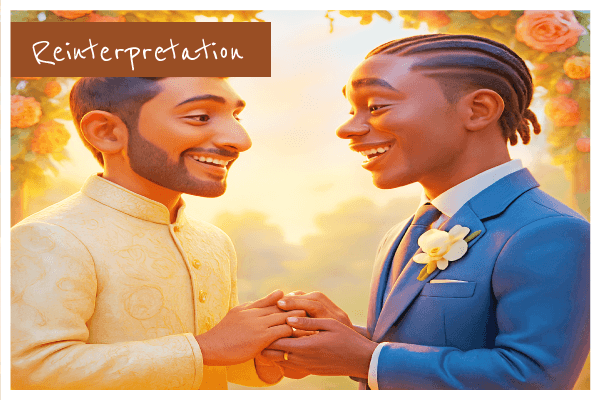
An argument frequently used in the media for some time is that the LGBTQIA+ community is trying to reinvent, reinterpret or even hijack the meaning of marriage; however, the concept of same-sex marriage is not new, and in reality, has been around for thousands of years. There are recorded mentions of same-sex marriages in Ancient Rome, as well as in other occurrences, such as a church wedding in 1061 in Spain, and countless examples of unions taking place throughout the centuries and across different cultures and civilisations. In modern times, it was not until October 1, 1989, that Denmark became the first nation to recognise same-sex unions, followed by full same-sex marriage rights recognition in the Netherlands on April 1st, 2001. Since then, 27% of all countries worldwide allow same-sex marriage, with Europe having the highest number of countries allowing same-sex unions or marriages at 70.8% (34 countries), followed by the Americas at 50.9% (27 countries). Africa has the lowest number of countries allowing same-sex marriages and unions at 7% or 4 countries, followed by Asia at 9.8% or 5 countries.
In other parts of Europe, in England and Wales, the Marriage Act 1836 legalised non-religious civil marriages, and civil marriages were legalised in the Italian Civil Code enacted in 1865 and in Germany in 1871. In the United States, licences were issued during the colonial era by local authorities and religious groups; however, by 1929, all states had laws requiring marriage licenses. In other parts of the world, Japan introduced consent into its marriage laws in 1889, requiring that both the bride and groom consent to the marriage for it to be legal, as previously, the bride’s consent was often forced. China introduced a new marriage law in 1950 that banned forced marriages, followed by Tunisia in 1956.
The changes to laws, even constitutions, in many countries reflected the right of individuals to marry, with or without religious ceremonies, and, at the same time, to receive rights and protections under the law. In most countries, married people gain significant legal rights, such as automatic parental responsibilities, tax benefits, including allowances, inheritance tax relief and spousal succession, housing rights, and a mutual duty of financial support. Not only economic, but also protections such as spousal privilege, which protect confidential communications between spouses from the courts and law enforcement. Other protections may include legal mechanisms to spouse in an abusive relationship, whereby they can go to court for an occupation order to protect themselves and their children.
Marriage, for some, is about legal protection and less about faith recognition. With governments separate from religious influence, especially those with a clear separation between church and state, recognising same-sex marriage is possible, just may not have happened, not because of religious beliefs, but more about political positions and policies. The question many ask is: why does legal recognition matter? Imagine for a moment, living your life with the same person, with whom you love, where you have built a home, created shared assets and made a life for yourselves. Without legal recognition, the laws of that country regarding inheritance matters, factors such as what assets are in which person’s name, and whether a last will and testament can be enforced will all likely have an impact. Without legal recognition, the surviving partner might have to pay taxes not only on what their partner owned, but also on their own share. Even estranged family members could claim all assets, shared or otherwise, leaving the surviving partner to lose part or all of what they effectively own, and whose partner would likely want them to have.
Not only losing shared assets, but, more importantly, being cut out of life-and-death decisions. Access to their partner while in hospital, being cut out of decisions being made, sometimes with those decisions being made by external family members, even those that might not have been in their partners’ lives for some time, and even making decisions that likely go against their wishes. Though the use of the term marriage for same-sex relationships caused problems for some to accept, it meant that countries created a workaround by using terms such as civil partnerships or unions. Many of these alternative legal mechanisms have the same rights and privileges, but with certain limitations, such as being able to call themselves married or their partners their husband or wife, effectively the terms many of us associate with being married. For some, especially those from a faith background, alternative legal mechanisms are not enough; that being denied marriage is discriminatory, and they want to be married and recognised by their faith and their family.
An argument frequently used in the media for some time is that the LGBTQIA+ community is trying to reinvent, reinterpret or even hijack the meaning of marriage; however, the concept of same-sex marriage is not new, and in reality, has been around for thousands of years. There are recorded mentions of same-sex marriages in Ancient Rome, as well as in other occurrences, such as a church wedding in 1061 in Spain, and countless examples of unions taking place throughout the centuries and across different cultures and civilisations. In modern times, it was not until October 1, 1989, that Denmark became the first nation to recognise same-sex unions, followed by full same-sex marriage rights recognition in the Netherlands on April 1st, 2001. Since then, 27% of all countries worldwide allow same-sex marriage, with Europe having the highest number of countries allowing same-sex unions or marriages at 70.8% (34 countries), followed by the Americas at 50.9% (27 countries). Africa has the lowest number of countries allowing same-sex marriages and unions at 7% or 4 countries, followed by Asia at 9.8% or 5 countries.
Today, during marriage debates, you will often hear people claim that same-sex marriages go against tradition, that they go against the teachings of many of the main denominations, or an argument used less frequently now, is that they devalue the institution for the majority, who are heterosexual and in male-female unions. All of those arguments may feel real to some; however, they are fundamentally flawed, ignoring history and the evolution of their faith on the subject. Many religions, including those from the major denominations, as well as those seen as more traditionalist, are slowly beginning to relax, ease, or thaw their positions. The reality is that marriage is not being redefined; it is just being opened up to all.
In a democratic society, one that is considered secular, meaning the church and state are separate and where same-sex marriage is not formally recognised, the resistance or restrictions imposed are not due to a theological position or even for respect of the institution; instead, it is being used as a political tool and the mercy and whims of the political class. Marriage is more than just a religious ritual; it has legal recognition and protection.
If the term marriage is applied, irrespective of faith, civil or otherwise, then distinguishing the legal rights and definitions for same-sex couples creates inequality and lessens the commitment of love and the union. The ability for a person to follow a faith and hold their beliefs is vital; so too is the ability for consenting adults, in a loving and committed relationship, to form a legal and spiritual union, regardless of how they love or how they choose to identify.
For many, marriage is a fundamental right, not a point of debate by politicians, or that their rights are being affected, stopped, taken away, or even decided because some people who are vocal and forcing their will on others, especially when they are not directly involved or even remotely affected or impacted by the lives or marriages of these same-sex couples. If you take away anything from this article, it is this: marriage is a commitment of love, a union formed as a show of long-term commitment, with both legal recognition and protection in mind. All those wishing to marry should not have conditions or restrictions imposed on them, especially when they are consenting, loving adults living their lives, just because of who they love or how they choose to identify.
Stay safe and until the next time.
In a democratic society, one that is considered secular, meaning the church and state are separate and where same-sex marriage is not formally recognised, the resistance or restrictions imposed are not due to a theological position or even for respect of the institution; instead, it is being used as a political tool and the mercy and whims of the political class. Marriage is more than just a religious ritual; it has legal recognition and protection.
If the term marriage is applied, irrespective of faith, civil or otherwise, then distinguishing the legal rights and definitions for same-sex couples creates inequality and lessens the commitment of love and the union. The ability for a person to follow a faith and hold their beliefs is vital; so too is the ability for consenting adults, in a loving and committed relationship, to form a legal and spiritual union, regardless of how they love or how they choose to identify.
For many, marriage is a fundamental right, not a point of debate by politicians, or that their rights are being affected, stopped, taken away, or even decided because some people who are vocal and forcing their will on others, especially when they are not directly involved or even remotely affected or impacted by the lives or marriages of these same-sex couples. If you take away anything from this article, it is this: marriage is a commitment of love, a union formed as a show of long-term commitment, with both legal recognition and protection in mind. All those wishing to marry should not have conditions or restrictions imposed on them, especially when they are consenting, loving adults living their lives, just because of who they love or how they choose to identify.
Stay safe and until the next time.
Discover all countries that have legalised same-sex marriages and unions worldwide. Search by using the interactive map or searching or filtering the worldwide table.

Acceptance and coming to terms with a part of what makes you can be challenging for many people. The Gayther pride in series is about celebrating all things relating to sexualities, gender identities and special groups. Showcasing the exceptional people, interesting facts and ways to connect with those unique communities
Learn more about how individual countries and regions around the world treat members of the LGBTQIA+ community. From the status and laws of same-sex marriages to gender identity recognition, this easy-to-use equality index provides a score and breakdown for every country worldwide.



IMPORTANT DISCLAIMER: All published articles have been written by members of the general public. Many will likely not be journalists nor be affiliated with any professional bodies associated with members of the media. The articles will likely be based on the authors’ own opinions, views, and experiences. Gayther does not endorse or accept any responsibility or liability regarding any materials within the news and media pages. This page may contain external links to third party websites; Gayther provides these links for your convenience and does not endorse, warrant or recommend any particular products or services. By clicking on any external links, you will leave Gayther and be taken to the third-party website, which you do so at your own risk and by accessing the site, you will be required to comply with the external third party’s terms and conditions of use and privacy policies
Discover all of the topical articles written by people from across the community and friends, all sharing their stories, opinions and experiences