









Cruise Culture:
GAY CRUISES FOR LGBTQIA+ ADVENTURERS
- Atilla Tiriyaki
- Average Reading Time: 14 minutes
- Travel
- articles, atillat, guides
Set sail and create unforgettable experiences and memories. Imagine a holiday where everything you want or need is only a short walk away, and you never have to look over your shoulder or think twice. No code-switching or discreet signalling, just open water with like-minded people. A gay cruise is not just a holiday; it’s a full-blown experience. Today’s cruises are vibrant, inclusive floating resorts at sea, where LGBTQIA+ travellers can explore the world while feeling completely safe, seen, and celebrated. Forget outdated stereotypes. Modern ships are floating resorts packed with quality entertainment, standout dining, and a real sense of community. Whether it’s your first time on deck or you’re a seasoned cruiser, expect more than a getaway. Think connection, freedom, and adventure, all wrapped into one all-encompassing journey. It’s no surprise that more LGBTQIA+ travellers than ever are choosing to see the world this way.
DISCLAIMER
All published articles are intended for an audience aged 18 years and over and have been written by members of the general public. Many will likely not be journalists nor be affiliated with any professional bodies associated with members of the media. The articles will likely be based on the authors' own opinions, views, and experiences...more
In the gay community, the word cruising often carries a different meaning or connotation, likely with many people thinking of individuals out on the hunt for people like them. In this article, we are using the term to explore gay cruising, part of the billion-dollar cruise industry, and all of the people aboard luxury liners heading to fun and exotic locations on the open seas.
Traditionally, the cruise industry was often seen as exclusive to older people or the wealthy. In reality, it has long been evolving, with shifts in both its clientele and its passengers’ average age. Today, you will see people from all age groups and socioeconomic backgrounds, as well as those who identify as members of the LGBTQIA+ community.
In terms of experiences, it is hard to find anything that compares, with cruise ships often wrongly compared to resort hotels, when in reality, the experience is very different from that of a conventional hotel or resort. From a facilities perspective, though the closest match would be an all-inclusive hotel, as both offer similar arrangements, cruise ships offer far more, including an in-house medical facility, an extensive range of entertainment options, multiple restaurants with different cuisines, roller coasters, casinos, in-house staff who are on call and live within the facility, and so much more.
Many who have experienced a cruise become among the biggest advocates for them, so let us explore the hype around the cruise industry, focusing specifically on gay cruises, how they have changed, and why they are now a viable option for all travellers, regardless of budget or geographical location.
Traditionally, the cruise industry was often seen as exclusive to older people or the wealthy. In reality, it has long been evolving, with shifts in both its clientele and its passengers’ average age. Today, you will see people from all age groups and socioeconomic backgrounds, as well as those who identify as members of the LGBTQIA+ community.
In terms of experiences, it is hard to find anything that compares, with cruise ships often wrongly compared to resort hotels, when in reality, the experience is very different from that of a conventional hotel or resort. From a facilities perspective, though the closest match would be an all-inclusive hotel, as both offer similar arrangements, cruise ships offer far more, including an in-house medical facility, an extensive range of entertainment options, multiple restaurants with different cuisines, roller coasters, casinos, in-house staff who are on call and live within the facility, and so much more.
Many who have experienced a cruise become among the biggest advocates for them, so let us explore the hype around the cruise industry, focusing specifically on gay cruises, how they have changed, and why they are now a viable option for all travellers, regardless of budget or geographical location.

Anyone going on a gay cruise will quickly realise that their fellow guests today are typically more varied in age. Looking around onboard, you will see people from ages 18-21 right up to those in retirement. Statistically, across the industry, the average age of passengers has decreased for both traditional and gay cruises, with the average age of those taking gay cruises now typically in the mid-forties to early fifties, ten to fifteen years younger than those who go on traditional cruises.
The shift in the types of people and ages of cruise-goers is partly due to holidaymakers, especially those who traditionally booked resort-like trips, becoming much more aware of the range of options and the cost-versus-value. Most cruise ships offer a range of accommodation options, with lower decks and rooms without portholes or windows among the cheaper options. The routes chosen, the time of year travelling, and any planned activities will also greatly impact the cost, as will availability, occupancy levels, and flexibility regarding travel. A Caribbean cruise taken during the late summer months will offer a very different experience from one during Pride Month in June.
One major advantage is the support offered to single travellers on gay cruises. Traditionally, anyone wanting to travel alone on a cruise would typically have to pay a single-occupancy rate, which is based on two people sharing a cabin or room. For example, if a cruise costs 150 dollars per person, per room, per day, then single travellers would pay 100% of the occupancy rate, effectively 300 dollars per day.
Unlike traditional cruise lines, where you travel with someone or pay a single-occupancy fee, many gay cruise operators offer not only a single-occupancy option but also a roomie option, in which single travellers are assigned rooms together to help reduce costs. In addition, for budget-conscious travellers, most rooms can accommodate three people so that you can share the cost and all receive a discounted rate by travelling together in one room.
For many cruise-goers, the value-for-money ratio is another major factor travellers are starting to wake up to and realise. It can be shocking, even seem expensive at first glance when seeing a lump sum or total cost of a cruise, often in the thousands, which can be off-putting, even intimidating; however, when you break the cost down, you quickly realise the value and, dare I say, the affordability. Let us explore this further.
Across the industry, the typical daily rate per person on a cruise is around $200, compared with, say, a city break in a major city, where an average night in a hotel will likely cost $250, or $125 per person. Now factor in food and dining, say $50 per day; getting around, say $20; and activities, around $50, and suddenly you are spending $250 per person each day, often without noticing it. Instead of paying upfront, you are paying in stages, even though you are in control of how much and when you spend it, it still contributes to the total cost of the trip.
In the cruise cost example, the $200 per person you are paying for the cruise includes your room, all your meals, access to all entertainment options, and use of facilities such as the gym, pool, lounges, library, and more. Not everything on a cruise is free. Typically, guests are required to pay for Wi-Fi, onshore excursions, alcoholic and fizzy drinks, and any purchases made in the onboard shops or at the casino. All of those charges, as well as any other additional costs, are added to your room via your guest card, and you will be required to settle them at the end of your trip. For many of the paid options, such as drinks and Wi-Fi, packages are often available. However, the majority of the fundamentals of a trip, food, cold and hot beverages, board, entertainment and on-board activities are included in the total cost of the cruise.
When booking a trip, it is important to establish what costs are included and whether items like visa fees, tipping, and gratuities are included. However, most operators will typically include these charges in the total cost you pay and will clearly outline what is not included.
The shift in the types of people and ages of cruise-goers is partly due to holidaymakers, especially those who traditionally booked resort-like trips, becoming much more aware of the range of options and the cost-versus-value. Most cruise ships offer a range of accommodation options, with lower decks and rooms without portholes or windows among the cheaper options. The routes chosen, the time of year travelling, and any planned activities will also greatly impact the cost, as will availability, occupancy levels, and flexibility regarding travel. A Caribbean cruise taken during the late summer months will offer a very different experience from one during Pride Month in June.
One major advantage is the support offered to single travellers on gay cruises. Traditionally, anyone wanting to travel alone on a cruise would typically have to pay a single-occupancy rate, which is based on two people sharing a cabin or room. For example, if a cruise costs 150 dollars per person, per room, per day, then single travellers would pay 100% of the occupancy rate, effectively 300 dollars per day.
Unlike traditional cruise lines, where you travel with someone or pay a single-occupancy fee, many gay cruise operators offer not only a single-occupancy option but also a roomie option, in which single travellers are assigned rooms together to help reduce costs. In addition, for budget-conscious travellers, most rooms can accommodate three people so that you can share the cost and all receive a discounted rate by travelling together in one room.
For many cruise-goers, the value-for-money ratio is another major factor travellers are starting to wake up to and realise. It can be shocking, even seem expensive at first glance when seeing a lump sum or total cost of a cruise, often in the thousands, which can be off-putting, even intimidating; however, when you break the cost down, you quickly realise the value and, dare I say, the affordability. Let us explore this further.
Across the industry, the typical daily rate per person on a cruise is around $200, compared with, say, a city break in a major city, where an average night in a hotel will likely cost $250, or $125 per person. Now factor in food and dining, say $50 per day; getting around, say $20; and activities, around $50, and suddenly you are spending $250 per person each day, often without noticing it. Instead of paying upfront, you are paying in stages, even though you are in control of how much and when you spend it, it still contributes to the total cost of the trip.
In the cruise cost example, the $200 per person you are paying for the cruise includes your room, all your meals, access to all entertainment options, and use of facilities such as the gym, pool, lounges, library, and more. Not everything on a cruise is free. Typically, guests are required to pay for Wi-Fi, onshore excursions, alcoholic and fizzy drinks, and any purchases made in the onboard shops or at the casino. All of those charges, as well as any other additional costs, are added to your room via your guest card, and you will be required to settle them at the end of your trip. For many of the paid options, such as drinks and Wi-Fi, packages are often available. However, the majority of the fundamentals of a trip, food, cold and hot beverages, board, entertainment and on-board activities are included in the total cost of the cruise.
When booking a trip, it is important to establish what costs are included and whether items like visa fees, tipping, and gratuities are included. However, most operators will typically include these charges in the total cost you pay and will clearly outline what is not included.
SAFETY AND PEACE OF MIND
When it comes to safety and peace of mind, cruise ships offer something unique to the LGBTQIA+ community. Under maritime law, when a ship is 12 nautical miles from any country’s shoreline, international law applies. While at port and when guests disembark, they are subject to local laws; however, once back on board, 12 miles offshore in international waters, the ship’s laws apply.
A cruise ship is typically governed by the laws of the country to which it is registered and from which it operates, known as the flag state. So, if the cruise operator is registered in a country, say in North America, Europe or Oceania, there is a good chance that the flag state has decriminalised same-sex relationships and has more progressive laws relating to the LGBTQIA+ community.
Now imagine that the cruise ship makes a port of call in a country that criminalises same-sex relationships. While in that country or at the dock, there is a risk to community members, but once back on board and at sea, the risk quickly disappears. This level of protection, coupled with discretion while onshore, enables the LGBTQIA+ community to make short trips to countries that are traditionally more hostile towards the community, allowing them to visit popular landmarks and scenery while significantly reducing risk by limiting their time and exposure there, an opportunity and level of protection that is not as easily possible with any other type of trip.
A cruise ship is typically governed by the laws of the country to which it is registered and from which it operates, known as the flag state. So, if the cruise operator is registered in a country, say in North America, Europe or Oceania, there is a good chance that the flag state has decriminalised same-sex relationships and has more progressive laws relating to the LGBTQIA+ community.
Now imagine that the cruise ship makes a port of call in a country that criminalises same-sex relationships. While in that country or at the dock, there is a risk to community members, but once back on board and at sea, the risk quickly disappears. This level of protection, coupled with discretion while onshore, enables the LGBTQIA+ community to make short trips to countries that are traditionally more hostile towards the community, allowing them to visit popular landmarks and scenery while significantly reducing risk by limiting their time and exposure there, an opportunity and level of protection that is not as easily possible with any other type of trip.
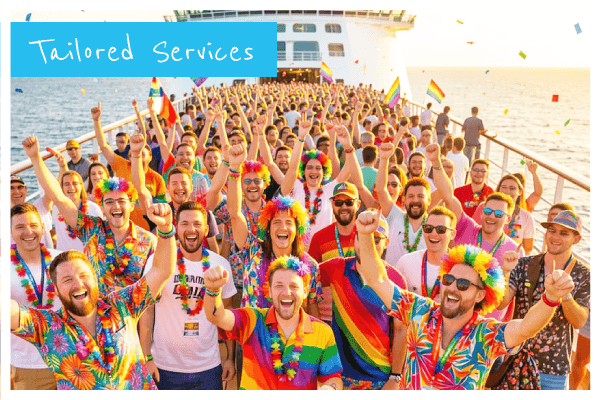
The experience and entertainment offered on traditional cruises are shaped by the operator, route, and clientele, all of which help determine the services and overall experience tailored to the audience. For example, most cruises offer daytime and evening entertainment, including singers, comedians, and other performers; many also host themed nights. On a gay cruise, especially during Pride Month, you will likely experience pride-themed celebrations and festivals, drag shows, and performances by popular and well-known singers, performers, and comedians, something you would not likely experience on a size and scale like that offered on traditional cruises.
The onboard entertainment team is adept at understanding and responding to its audience’s needs, so a ship with a high proportion of single travellers would likely host events that help people get to know one another, make friends, and ultimately feel included.
Though some of the evening events, especially the parties and themed nights, might be overwhelming and even seem wild to some, it is important to remember that participation is optional. While many of these are taking place, other entertainment options will be available throughout the ship. So, someone looking for a place to have a drink and chat with friends could spend time in the lounge.
The fun and festivities are not forced upon you. There are places to enjoy quiet time or to unwind as well. On many ships, there is a television in your cabin with a channel that provides updates on all matters related to the cruise, including upcoming entertainment options, weather conditions, journey-related information, and more. The channel is ultimately designed to keep you informed and ensure that you never miss an event or attraction.
The onboard entertainment team is adept at understanding and responding to its audience’s needs, so a ship with a high proportion of single travellers would likely host events that help people get to know one another, make friends, and ultimately feel included.
Though some of the evening events, especially the parties and themed nights, might be overwhelming and even seem wild to some, it is important to remember that participation is optional. While many of these are taking place, other entertainment options will be available throughout the ship. So, someone looking for a place to have a drink and chat with friends could spend time in the lounge.
The fun and festivities are not forced upon you. There are places to enjoy quiet time or to unwind as well. On many ships, there is a television in your cabin with a channel that provides updates on all matters related to the cruise, including upcoming entertainment options, weather conditions, journey-related information, and more. The channel is ultimately designed to keep you informed and ensure that you never miss an event or attraction.
WHAT IS IT LIKE ONBOARD/EXPERIENCE
When you check in, you will typically hand over your passport to the operator. By keeping your passport for the duration of the cruise, the operator will facilitate immigration at each port, so your passenger ID is important both on board the ship and at the port. Cruise ships are typically large, like complexes on water, with multiple levels, restaurants, gyms, bars, casinos, swimming pools and recreation areas on the top levels of the ship. The ship will have a formal dining option, a buffet restaurant, and cuisine-themed restaurants. You might have to pay a small charge for the specialist restaurants, while the fine dining and buffet are typically included in the cost of your cruise. The reality is that if you are hungry or thirsty, you can easily get a meal or a snack on board at virtually any point throughout the day.
Onboard activities take place throughout the day, and whether you feel like taking part in the fun or simply enjoying the sun and sea at the poolside, the choice is yours. In the evenings, if you opt for fine dining, you will typically need to reserve a seating time, whereas the buffet restaurant operates on a first-come, first-served basis.
When docked, you can disembark and explore the onshore activities, or stay on board and continue enjoying the ship and its facilities. When making purchases on board, you will typically use your room card and will be required to settle up at the end of the cruise.
Simply put, cruises are a unique experience where you can choose and control your level of participation. From what to eat to what not to, you will typically have multiple options available to you.
Onboard activities take place throughout the day, and whether you feel like taking part in the fun or simply enjoying the sun and sea at the poolside, the choice is yours. In the evenings, if you opt for fine dining, you will typically need to reserve a seating time, whereas the buffet restaurant operates on a first-come, first-served basis.
When docked, you can disembark and explore the onshore activities, or stay on board and continue enjoying the ship and its facilities. When making purchases on board, you will typically use your room card and will be required to settle up at the end of the cruise.
Simply put, cruises are a unique experience where you can choose and control your level of participation. From what to eat to what not to, you will typically have multiple options available to you.

Cruises are global, and where you go and what you do will depend on the route and the time of year. You might visit one or more countries, see landmarks and local sights, often hundreds, if not thousands, of miles apart, experience new cultures, and meet new people.
Like most cruises, gay cruises attract people from all around the world and from different age groups and backgrounds. Though the ships are big, there are vast numbers of activities taking place at any given point in time, which means you might not bump into the same people regularly, if at all. The experience is a unique opportunity to connect with people and the community.
An opportunity not only to meet new people you might not otherwise meet, but also to create meaningful connections. When meeting new people, you have the flexibility to make arrangements, whether meeting for dinner, for drinks, to sit by the pool, or to take a stroll along the ship’s promenade. You will have the opportunity and means to connect with people from around the world and, hopefully, to make long-lasting connections.
The key to all cruises, especially gay cruises, is the creation of judgment-free environments where consenting adults can have fun in spaces dedicated to facilitating that. Those not looking for specific experiences will be able to find something that suits them. Typically, the cruise experience offers something for everyone, or nearly all needs, at any given time. The cruise ships will have rules and etiquette that all guests and staff must follow at all times; however, the focus is ultimately on having fun in a safe and welcoming space.
Like most cruises, gay cruises attract people from all around the world and from different age groups and backgrounds. Though the ships are big, there are vast numbers of activities taking place at any given point in time, which means you might not bump into the same people regularly, if at all. The experience is a unique opportunity to connect with people and the community.
An opportunity not only to meet new people you might not otherwise meet, but also to create meaningful connections. When meeting new people, you have the flexibility to make arrangements, whether meeting for dinner, for drinks, to sit by the pool, or to take a stroll along the ship’s promenade. You will have the opportunity and means to connect with people from around the world and, hopefully, to make long-lasting connections.
The key to all cruises, especially gay cruises, is the creation of judgment-free environments where consenting adults can have fun in spaces dedicated to facilitating that. Those not looking for specific experiences will be able to find something that suits them. Typically, the cruise experience offers something for everyone, or nearly all needs, at any given time. The cruise ships will have rules and etiquette that all guests and staff must follow at all times; however, the focus is ultimately on having fun in a safe and welcoming space.
Affordable solutions to suit all budgets, with inclusive, worry-free travel for the LGBTQIA+ community. Whether single or in a committed or open relationship, gay cruisers can explore new places, access a wide range of entertainment, enjoy good food and drinks, and meet like-minded people in an inclusive, welcoming space.
When you arrive at the port to meet the ship, once on board, the operator takes care of all your needs and helps shape your experience throughout the cruise.
Gay cruises are adult-only for a good reason. Not because passengers behave differently from those on traditional cruises, but rather to help create a safe, open space for people to be themselves and to offer activities tailored to a more adult audience.
Next time you see an advert for a gay cruise or are planning your next holiday, look closely at what is on offer. Do not be put off by the total price; review the breakdown and compare it with what you would likely spend if you were to arrange a trip yourself. When considering the trips you typically book, how much do you usually spend, or are you willing to spend, especially when you factor in transport, accommodation, food and drink, and use this insight to compare the total cost of a cruise to your usual type of holiday, effectively, a like-for-like comparison.
Anyone who has been on a cruise will typically advocate for them, highlighting the value for money, the quality of the service, the ease of travel, and, most importantly, the meaningful connections you will likely make during your trip.
If you have never been on a gay cruise, why not explore the options, learn what you might experience, and see how it might work for you?
Stay safe and bon voyage.
When you arrive at the port to meet the ship, once on board, the operator takes care of all your needs and helps shape your experience throughout the cruise.
Gay cruises are adult-only for a good reason. Not because passengers behave differently from those on traditional cruises, but rather to help create a safe, open space for people to be themselves and to offer activities tailored to a more adult audience.
Next time you see an advert for a gay cruise or are planning your next holiday, look closely at what is on offer. Do not be put off by the total price; review the breakdown and compare it with what you would likely spend if you were to arrange a trip yourself. When considering the trips you typically book, how much do you usually spend, or are you willing to spend, especially when you factor in transport, accommodation, food and drink, and use this insight to compare the total cost of a cruise to your usual type of holiday, effectively, a like-for-like comparison.
Anyone who has been on a cruise will typically advocate for them, highlighting the value for money, the quality of the service, the ease of travel, and, most importantly, the meaningful connections you will likely make during your trip.
If you have never been on a gay cruise, why not explore the options, learn what you might experience, and see how it might work for you?
Stay safe and bon voyage.

With countries around the world treating members of the LGBTQIA+ community differently, planning an overseas trip can be challenging. With over 233 country and 435 regional guides, Gayther Guides provides all the information you need to plan your trip.

Learn more about how individual countries and regions around the world treat members of the LGBTQIA+ community. From the status and laws of same-sex marriages to gender identity recognition, this easy-to-use equality index provides a score and breakdown for every country worldwide.

Learn more about the exceptional LGBTQIA+ community, discover the community’s history, the ongoing movement for equality, the size of the community and how much it contributes to the world economy, frequently asked questions and much more.






IMPORTANT DISCLAIMER: All published articles have been written by members of the general public. Many will likely not be journalists nor be affiliated with any professional bodies associated with members of the media. The articles will likely be based on the authors’ own opinions, views, and experiences. Gayther does not endorse or accept any responsibility or liability regarding any materials within the news and media pages. This page may contain external links to third party websites; Gayther provides these links for your convenience and does not endorse, warrant or recommend any particular products or services. By clicking on any external links, you will leave Gayther and be taken to the third-party website, which you do so at your own risk and by accessing the site, you will be required to comply with the external third party’s terms and conditions of use and privacy policies
Discover all of the topical articles written by people from across the community and friends, all sharing their stories, opinions and experiences