







LGBTQIA+ Travel Guides:
Destination San Francisco
- Atilla Tiriyaki
- Average Reading Time: 25 minutes
- Travel
- articles, atillat, guides
Modern San Francisco not only embraces the LGBTQIA+ community; it is this community that helped shape the city into what it is today. Known as the Golden City, this iconic destination boasts a rich history of hard-fought pride, self-expression, and resilience. From the rainbow-flagged streets of the Castro to the revered halls of its historic landmarks, every corner tells a story. Whether you’re following in the footsteps of trailblazers, riding the famous cable cars, raising a glass in one of its legendary bars, or simply soaking up the atmosphere in an inclusive environment, San Francisco is not just a place to visit; it’s a place to feel welcomed and become part of LGBTQIA+ history.
DISCLAIMER
All published articles are intended for an audience aged 18 years and over and have been written by members of the general public. Many will likely not be journalists nor be affiliated with any professional bodies associated with members of the media. The articles will likely be based on the authors' own opinions, views, and experiences...more
Located on the west coast of the United States, the city is part of the San Francisco Bay Area, commonly called the Bay Area, which is home to approximately 7.8 million residents, with over 870,000 living in and around the city centre. San Francisco, both the city and the county, is in California and ranks as the state’s fourth-largest city. The area has a long history, dating back more than 6,000 years, during which the Yelamu, a local tribe of the Ohlone people, inhabited the bay area.
The city is known as the Golden City, a nickname given during the California Gold Rush of 1849 when rapid growth and development made it the largest city on the West Coast. Today, the Bay Area and the city are recognised for their prestigious universities, such as Stanford and the Wharton School, and for Silicon Valley, the hub of the high-technology industry, with companies headquartered there, including Meta, OpenAI, Anthropic, Apple, Google, and many others.
San Francisco is located in the northern part of the San Francisco Peninsula and is famous for its steep hills, with over 50 within the city limits. Many neighbourhoods are named after the hills they are on, such as Nob Hill and Russian Hill. The highest hill is Mount Davidson, and the two hills called Twin Peaks are among the city’s highest points.
The city has over 80 districts and comprises 10 islands, with a further 20 islands in the wider Bay Area. San Francisco spans approximately 121 square kilometres (46.9 square miles) and is popular both nationally and internationally, attracting nearly 2 million overseas visitors and 20 million domestic visitors. Visitors come to see some of the remarkable landmarks, such as the Golden Gate Bridge, ride the cable cars, or visit the island of Alcatraz.
Some interesting facts you might not know:
The city is known as the Golden City, a nickname given during the California Gold Rush of 1849 when rapid growth and development made it the largest city on the West Coast. Today, the Bay Area and the city are recognised for their prestigious universities, such as Stanford and the Wharton School, and for Silicon Valley, the hub of the high-technology industry, with companies headquartered there, including Meta, OpenAI, Anthropic, Apple, Google, and many others.
San Francisco is located in the northern part of the San Francisco Peninsula and is famous for its steep hills, with over 50 within the city limits. Many neighbourhoods are named after the hills they are on, such as Nob Hill and Russian Hill. The highest hill is Mount Davidson, and the two hills called Twin Peaks are among the city’s highest points.
The city has over 80 districts and comprises 10 islands, with a further 20 islands in the wider Bay Area. San Francisco spans approximately 121 square kilometres (46.9 square miles) and is popular both nationally and internationally, attracting nearly 2 million overseas visitors and 20 million domestic visitors. Visitors come to see some of the remarkable landmarks, such as the Golden Gate Bridge, ride the cable cars, or visit the island of Alcatraz.
Some interesting facts you might not know:
- San Francisco, which means Saint Francis in Spanish, had a different name for over seventy years. When the city was founded by Spanish explorer Juan Bautista de Anza in 1776, he named the settlement Yerba Buena, meaning ‘good herb’. This name was given because of the wild mint that grew abundantly in the area at that time. The city was renamed San Francisco in 1847, a shortened form of the mission’s name, which Spanish colonists established when they made the settlement permanent. Led by Father Serra, the mission was dedicated to San Francisco de Assisi and was commonly known as Mission Dolores. At that time, it was the northernmost mission of the church and the Spanish empire. The famous name was shortened, and today the city is known by many nicknames, including San Fran, the Golden City, Golden Gate City, Fog City, 415, and Frisco, with the abbreviation SF often used. Even the fog, which frequently covers the hills surrounding the city for more than 100 days each year, has a nickname; many locals call it Karl.
- The area where the city is situated has been inhabited for over 6,000 years, dating back to around 3,000 BC. The Ohlone people were the original inhabitants of the city and its surrounding region, speaking the language known as Ramaytush, and they were the native tribe of Yelamu. When the Spanish settlers arrived in San Francisco, the landscape was notably different: over 3,000 acres of the western part of the city consisted of sandy dunes called Outside Lands.
- The city was part of the Spanish Empire in the region known as Las Californias until 1821, when the area was transferred to Mexico at the end of the 11-year-long Mexican War of Independence. The newly ceded territory remained under Mexican control for only 27 years; as more American and European settlers arrived, the United States began the military campaign known as the Conquest of California, and San Francisco was captured in 1846. At the end of the Mexican-American War, which lasted less than two years, the two countries signed a peace treaty, the Treaty of Guadalupe Hidalgo, in 1848, through which modern-day California came under US control. In 1850, the state of California, which includes San Francisco, became the 31st state of the United States of America.
- Both the city and the county of San Francisco have a flag. The current flag, adopted in 1940, remains in use today. It depicts a rising phoenix on a white background with a yellow border, symbolising the city’s resilience in the face of the 1906 earthquake and subsequent fires. The phoenix has been a symbol of San Francisco since at least 1852 and appears on the city’s first official seal. Beneath the phoenix, you will find the city’s official Latin motto, ‘Oro en Paz. Fierro en Guerra, which means ‘Gold in Peace, Iron in War.’
- One of the city’s most iconic landmarks is the Golden Gate Bridge. Opened in 1937, the suspension bridge spans 1.7 miles (2.7 kilometres), is 27 metres (90 feet) wide, and stands 746 feet (227 metres) high. The bridge, which crosses the one-mile-wide strait between the bay and the Pacific Ocean, was, when it opened, the longest and tallest suspension bridge in the world. The bridge even has an official colour, known as International Orange. During construction, there was considerable debate about the colour of the bridge, including proposals for red-and-white stripes and yellow-and-black lines. The final choice was actually based on the colour of the primer used to protect the steel. Associated with the bridge is one of the city’s most-visited parks, Golden Gate Park. It is the largest park in the city, covering around 412 hectares (1,000 acres), and attracts over 20 million visitors each year. The park has a shape similar to New York’s Central Park; however, Golden Gate Park is actually 20% larger.
- When most people think of San Francisco, they often picture the city’s steep roads and winding, chaotic streets. The city is built on more than 50 hills; some of San Francisco’s most famous hills include Twin Peaks, Telegraph Hill, and Russian Hill. The city also boasts the crookedest street and some of the steepest streets in the world. Lombard Street attracts millions of visitors each year who come to see the steep hill with its eight hairpin turns and a one-block section.
- No visit to the city is complete without a ride on the San Francisco cable car system. The city’s historic landmark, the first electric streetcar in San Francisco, began passenger service in 1892. Today, only three of the original twenty-three lines are still operating, consisting of 40 iconic single- and double-ended cars and covering a total distance of 5.1 miles (8.2 kilometres). The San Francisco cable car system remains the only manually operated cable car system still in use worldwide.
- Pets can be buried, but not people, within the city limits. In 1902, because the city was running out of burial space, the San Francisco Board of Supervisors voted to ban all burials within the city boundaries. When the law was enacted, many graves were relocated to Colma over more than twenty years, and today, only two cemeteries remain within the city. Although it is not possible to bury people in the city, the Presidio Pet Cemetery is the final resting place for over 400 pets belonging to military families living there.
- The charter of the United Nations (UN) was signed on 26 June 1945, in San Francisco, shortly after the end of the Second World War. The charter is the foundation of the United Nations, which is an important organisation with the principal mandate of “upholding higher standards of living for their citizens, addressing economic, social, health, and related problems and promoting universal respect for and observance of, human rights and fundamental freedoms for all without distinction as to race, sex, language, or religion.” Today, 193 UN Member States are represented in the General Assembly.
- The city is often regarded as the original gay-friendly city or the Gay Mecca due to its progressive history with the LGBTQIA+ community. Even today, it boasts one of the largest and most visible communities, with over 16% of adults estimated to identify as LGBTQIA+. The city is also home to the first openly gay neighbourhood in the United States, known as the Castro District. San Francisco has seen many LGBTQIA+ milestones in American history, including the first gay business association in the country (The Tavern Guild), the first gay liberation organisation (Vanguard), the first gay softball league in the world, the first openly gay politician elected to public office (Harvey Milk), and the location where Gilbert Baker’s first pride flag was raised at San Francisco Pride in 1978.
- San Francisco is an environmentally friendly city. Whether it is the fact that the city recycles more than 80 per cent of its waste, thereby reducing the amount sent to landfills, or that, since 2009, it has introduced the country’s first large-scale urban food waste and composting system, the city has numerous initiatives to help lower its carbon footprint. Since the 1990s, San Francisco has halved its greenhouse gas emissions and, in 2016, became the first city in the United States to pass a law requiring buildings with 10 levels or fewer to install rooftop solar panels.
- San Francisco remains a global technology hub. Since the renowned Silicon Valley is located on the southern shores of San Francisco Bay, the city’s tech reputation is well established; however, there are some facts you may not be aware of. Twitter, Airbnb, and Uber were all founded in the city during the 2000s, and Craigslist, the classified advertisements website, was established in 1995. San Francisco has also been the birthplace of many inventions, including the bendy straw and the electronic television.
San Francisco is located in Northern California on the West Coast of the United States. There are numerous daily flights, both domestic and international. Domestic flights usually last around 2 hours, whereas international flights take about 11 hours. Many direct and indirect routes are available to and from the city.
BY AIR
BY AIR
- Three major airports serve the San Francisco Bay Area, offering a wide range of domestic and international flights.
- San Francisco International Airport (///tall.tigers.feel – SFO (IATA) | KFSO (ICAO)) is an international airport and the largest in the Bay Area, as well as the second busiest in California. It is located 16 kilometres (10 miles) south-east of San Francisco’s centre, handling approximately 1,000 flights daily and around 54 million passengers annually. The airport serves as the main hub for United Airlines, Alaska Airlines, American Airlines, Air Premia, Air France, Air Canada, and Air China. The busiest domestic routes connect to Los Angeles (LAX), Chicago (ORD), and Denver (DEN). The most popular way to reach the airport is by BART (Bay Area Rapid Transit), which takes approximately 30 minutes. The Red or Yellow line trains run directly to downtown stations, take around 30 minutes, and cost about 10 US dollars round-trip. They typically run every 15 minutes from 5 am to midnight daily. Taxis cost around 50 US dollars, and the journey typically takes 30 minutes.
- Oakland San Francisco Bay Airport (///jukebox.tables.grab – OAK (IATA) | KOAK (ICAO)) is an international airport located in Oakland, California. The airport is 19 kilometres (12 miles) east of San Francisco, handling approximately 100 flights and 148,000 passengers daily. It serves as the main hub for FedEx Express and is the base for Southwest Airlines. The busiest routes include domestic destinations such as Los Angeles (LAX/SNA), San Diego (SAN), and Las Vegas (LAS). The most common way to access the airport is via BART (Bay Area Rapid Transit): take the Oakland-bound train to Coliseum Station, then transfer to the dedicated 8-minute BART train to OAK. This train operates every 6 minutes and takes about 8 minutes. The journey from downtown San Francisco to the airport typically takes 35-45 minutes, with departures every 15 minutes, and costs 11 US dollars each way. Taxis are available, with an average fare of 90 US dollars and a travel time of approximately 30 minutes.
- Mineta San Jose International Airport (///game.circle.ended – SJC (IATA) | KSJC (ICAO)) is an international airport situated in San Jose, making it the second busiest airport in the Bay Area. It is 74 kilometres (46 miles) southeast of San Francisco and handles approximately 170 departures daily, serving 12 million passengers annually. The airport is served by airlines such as Southwest Airlines and Alaska Airlines. The busiest routes connect to domestic destinations like San Diego (SAN), Los Angeles (LAX), and Seattle (SEA). The most common way to reach the airport is to use Caltrain and the free shuttle service. You can take the southbound shuttle from San Francisco (4th & King or 22nd St) to Santa Clara Station or use the Green (Berryessa) BART line to Milpitas Station, then transfer to the VTA Route 60 Airport Flyer bus. The Caltrain journey takes between 30 and 60 minutes, runs every 15 to 30 minutes, and costs around 12 US dollars. The BART operates every 20 to 30 minutes and takes about 40 minutes. The VTA Route 60 bus is free to ride. Taxis are also available, costing around 100 US dollars and taking roughly an hour.
- There are two cruise terminals serving San Francisco.
- Pier 27 – James R. Herman Cruise Terminal (///raced.mirror.settle) is the main cruise hub, hosting the majority of the city’s cruise ships and passengers. Several major cruise lines, including Princess Cruises, Carnival, Royal Caribbean, Celebrity Cruises, Holland America, Norwegian, and Viking Cruises, operate from this terminal, which primarily serves cruise operators. The port typically handles around 400,000 passengers each year and over 100 cruise calls. The terminal is located on the northern waterfront of The Embarcadero and is approximately a 20-minute walk to the Embarcadero BART/Muni station.
- Pier 35 (///risky.accent.tall) serves as an overflow terminal for Pier 27, which can only accommodate one cruise ship at a time, while Pier 35 can handle two or more ships simultaneously. Many of the same cruise lines, including Princess Cruises, Carnival, Royal Caribbean, Celebrity Cruises, Holland America, Norwegian, and Viking Cruises, also utilise this terminal. It also welcomes smaller vessels such as the RMS Queen Mary 2. Located on the northern waterfront of The Embarcadero, it is about an 8-minute walk north of Pier 27. The nearest streetcar stop is at The Embarcadero/Bay Street.
- International transfers directly to San Francisco are not available. Canadian travellers can take the Amtrak Cascades train from Vancouver to Seattle, which takes approximately 5 hours. They can then continue on the Coast Starlight, a journey of about 35 hours, stopping in Los Angeles, where a connection to the Bay Area is necessary.
- The main intercity train station in San Francisco is the 4th and King Street Station in Caltrain (///skinny.laying.wipes), which serves the peninsula and Santa Clara Valley, with routes that include San Jose Diridon, Palo Alto, and Redwood City, as well as transfers to San Francisco International Airport.
- Emeryville Amtrak Station (///riders.studio.crunch), situated north of Oakland and across the San Francisco Bay from the city, provides daily services to Chicago (Amtrak California Zephyr), passing through the Rocky Mountains and Sierra Nevada, as well as to Los Angeles (Amtrak Coast Starlight) and San Jose.
- Oakland Amtrak Station (///bike.decay.hidden), situated south of Emeryville and across the San Francisco Bay from the city, offers frequent train services to Sacramento (Amtrak Capitol Corridor), San Jose, Bakersfield (Amtrak San Joaquins), and Fresno. Tickets can be booked directly through Amtrak or at all major stations.
- The main bus terminal in San Francisco is at the Salesforce Transit Center (///dreams.spoke.smug) on 425 Mission Street in the city centre. The station offers daily services to more than 25 cities across the United States, operated by Greyhound and FlixBus.
- Popular routes to the city include services from Los Angeles (around 8 hours), San Diego, and Sacramento. Costs can vary from 10 US dollars to several hundred, depending on the destination and service frequency. Typically, buses are equipped with free Wi-Fi, power outlets, and restrooms.
- Tickets can be booked directly with Greyhound and FlixBus USA, as well as through comparison services such as Wanderu and BusBud.
Interactive Airport Terminal Maps
Discover the interactive travel maps on Gayther. Zoom in and click on individual stations, see all of the lines and much more
San Francisco has a comprehensive public transport system. There are many ways to get around, including Muni buses, cable cars, rideshares, and the BART (Bay Area Rapid Transit). A popular way to see the city is by cycling. San Francisco operates a public bike-sharing scheme, Bay Wheels, managed by Lyft, with over 7,000 traditional and electric bikes at more than 550 stations throughout the city. The bikes can be booked via the app (iOS | Android). A typical single ride costs 1 US dollar, and a day pass generally costs around 15 US dollars. For those exploring San Francisco by public transport, BART and Muni are quick and convenient ways to travel across the city. Nearly all of the transport system is cashless, requiring pre-paid tickets or purchases made at specific locations or online. Cash is accepted on Muni buses; however, you must have exact change. On cable cars, it is recommended to buy tickets in advance to avoid disappointment.
- The Bay Area Rapid Transit, or BART, is a public rail system serving San Francisco and the surrounding Bay Area. BART has five main colour-coded lines (Yellow, Red, Blue, Green, and Orange), with 50 stations (19 surface, 15 elevated, 16 subway), and extends for 131 miles (211 kilometres). The Downtown SF BART includes the main stations Embarcadero, Montgomery St., Powell St., and Civic Centre/UN Plaza, offering connections to nearby areas and the airport. BART operates from 5 am to midnight on weekdays, and you can pay for travel using a digital or physical Clipper card, which is required for entry and exit. You can top up your Clipper card via Apple Wallet or Google Pay, and a standard journey costs around 5 US dollars.
- The San Francisco Municipal Railway (Muni) network includes a bus fleet, trolleybuses, light rail (Muni Metro), and historic cable cars. The Muni bus fleet comprises 550 diesel-electric hybrid buses and 300 electric trolleybuses (ETBs). The network serves over 70 routes, such as Rapid (R), Express (X), and Owl (late-night). Normal operating hours are from 5 am to midnight, with Owl services running from 12 am to 5 am. Payment options include a Clipper card, the Muni Mobile App, PayPal, Apple Pay, Google Pay, or cash. Exact change is required. For further information about the Muni network, visit the SFMTA website.
- San Francisco’s iconic cable cars are the last manually operated cable car system and a National Historic Landmark. The network includes three lines: Powell-Hyde (Line 60), Powell-Mason (Line 59), and California Street (Line 61). It covers 4.7 miles (7.5 km) of track, runs at a consistent 9.5 mph, and typically operates every 10-20 minutes, depending on the time of day, with an average journey time of 15-25 minutes. You can board the cable cars at the starting turntables or at one of the stops marked with a brown-and-white sign along the route. A single journey costs approximately 9 US dollars, and you can purchase a ticket in advance using Muni Mobile, Clipper Card, or cash. Exact change is required. For more information, visit the SFMTA website.
- The official taxis in San Francisco are metered and are legally required to display “San Francisco Taxicab” on both sides and the rear of the vehicle. A “Taxi” sign is on the taxi’s roof, and the light will illuminate when the taxi is available. The driver must display their ID and a metal licence plate prominently inside the vehicle. There are over 1,800 officially licensed taxis in the city that can be hailed from the street, at taxi stands at major hotels, transit hubs, and airports, and through mobile apps. The standard metered fare is $ 4.15 for the first one-fifth mile and $0.65 for each additional one-fifth mile, or $0.65 per minute during traffic delays or while waiting. The city also has Uber, Lyft, and rideshare services such as Wingz.
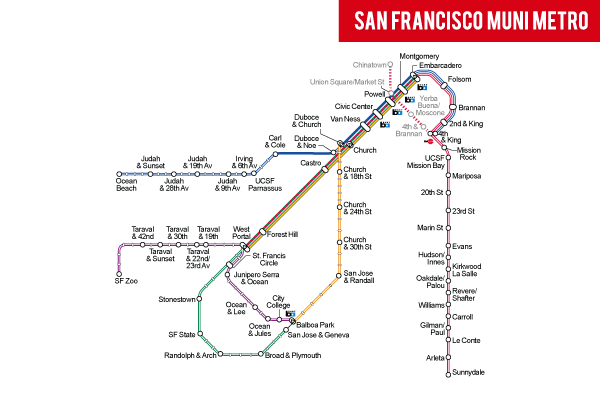
Interactive Travel Information
Discover the interactive travel maps on Gayther. Zoom in and learn more about individual stations, all of the lines and much more
San Francisco offers a wide range of accommodation options, from luxury hotels to cosy hostels. Prices and availability vary by neighbourhood and proximity to major attractions. The average nightly rate in the city is around 300 US dollars. With over 250 hotels and nearly 36,000 rooms, central areas such as Union Square, Fisherman’s Wharf, and Nob Hill can be difficult to secure during busy periods; therefore, booking in advance is recommended to avoid disappointment. In addition to the room rate, hotel providers and short-term rentals (like Airbnb) usually charge a 14% Transient Occupancy Tax (TOT) for stays under 30 days, along with an 8.625% sales tax. Extra charges are often added at check-in or check-out, so it is wise to confirm these fees with your accommodation provider before making your reservation.
- Hotel Nikko San Francisco (///moons.every.angle) is situated on Mason Street in downtown San Francisco. The hotel is only a short walk from Union Square, the Theatre District, and many local landmarks and attractions. This Japanese-inspired hotel has 532 guest rooms, including 22 suites, ranging from standard to imperial club rooms. The rooms feature floor-to-ceiling windows, many offering bay views, refrigerators, and large flat-screen televisions. Hotel Nikko offers a health club and fitness centre with dry saunas and steam rooms, a spacious glass-roofed pool and whirlpool, Feinstein’s at the Nikko, a 140-seat cabaret and live music venue, and an on-site sustainable California-Asian fusion restaurant called Anzu. The average cost for a standard room is approximately 340 US dollars per night, with various room options available. For more information about the hotel, please visit the Hotel Nikko San Francisco website.
- The citizenM San Francisco Union Square (///bench.lowest.shirt) is situated in Union Square, the heart of downtown San Francisco. The hotel is close to the San Francisco Museum of Modern Art and many popular landmarks and attractions, such as Powell Street Cable Cars, Chinatown, and Fisherman’s Wharf. It offers 195 tech-enabled rooms across 9 floors, with king-size beds, smart iPad controls for lighting and climate, and powerful rainfall showers. The hotel also provides a 24/7 dining option called the canteenM, a stylish co-working lobby, a 24-hour gym, and a fully cashless self-check-in process. The average price for a standard room is approximately 250 US dollars, and the hotel features a variety of room options. For more information about the hotel, please visit the citizenM San Francisco Union Square website.
- The Green Tortoise Hostel (///really.notion.deeply) is located on Broadway in the North Beach neighbourhood, known as the city’s Little Italy. Within walking distance of Chinatown, Coit Tower, and the Embarcadero, it is a popular, highly-rated hostel among many young travellers, celebrated for its social atmosphere. It offers 40 guest rooms within this historic, distinctive building. The available rooms range from private to dormitories, co-ed to female-only, and include a 24-hour reception, a large, fully equipped communal kitchen, a dining hall, a dry sauna, and ten shared bathrooms. Guests can enjoy a complimentary breakfast, free Wi-Fi, and free tea and coffee throughout their stay. The average nightly rate is approximately 60 US dollars, and the hostel provides a variety of room options. For more information, please visit the Green Tortoise Hostel’s website.
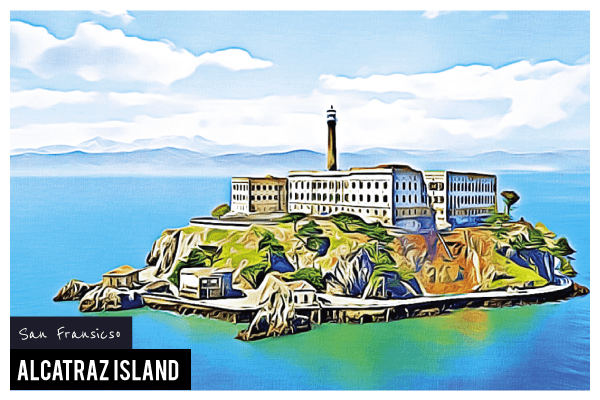
San Francisco is a city on a 7-by-7-mile peninsula and is home to many iconic landmarks, including the Golden Gate Bridge and Alcatraz Island. The Waterfront at Fisherman’s Wharf and Pier 39 are popular tourist attractions where visitors can see resident sea lions, brown pelicans, Western gulls, and other wildlife. The city is known for its winding streets, steep hills, distinctive Victorian architecture, numerous open spaces, and historic landmarks.
- Alcatraz Island (///shady.quiet.heads) is situated 1.3 miles or 2 kilometres off the coast of San Francisco and is a small island covering just 22 acres. The island was initially established as a lighthouse in the mid-19th century and later served as a military fortification and prison. In 1934, it became home to the federal prison, Alcatraz Federal Penitentiary. The prison, which held 336 inmates, was infamous for being nearly impossible to escape from due to the strong tidal currents and freezing waters surrounding the island. It housed some of the most notorious criminals of the era, including Al ‘Scarface’ Capone, Robert Stroud, the ‘Birdman of Alcatraz’, George ‘Machine Gun’ Kelly, and James ‘Whitey’ Bulger. The prison officially closed on 21 March. Today, it attracts over 1.4 million visitors each year. Tourists can visit the island via Alcatraz City Cruises, which depart from 9 am to 5-6 pm daily. Tours cost approximately 50 US dollars. For more information, visit the Alcatraz Island website.
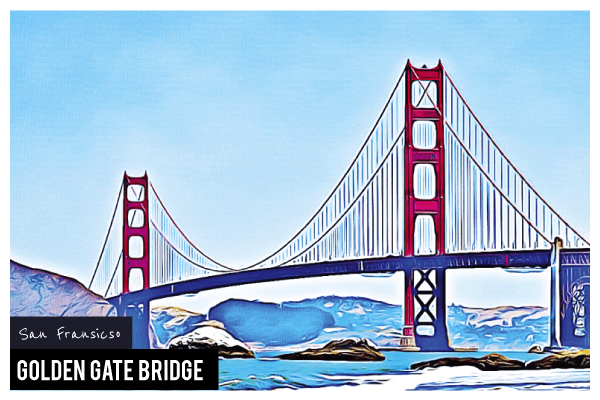
- The Golden Gate Bridge (///super.skirt.letter) is a 1.6-kilometre (or 1-mile) long Art Deco suspension bridge that spans the Pacific Ocean in California, connecting San Francisco Bay from the peninsula to Marin County via US Route 101 and California State Route 1. The iconic bridge opened on 27 May 1937 as the world’s longest suspension bridge at the time, a title it held for 27 years. This renowned landmark is known to expand and contract by up to 4.9 metres (16 feet) in heat and sway as much as 8.2 metres (27 feet) in strong winds. Sidewalk handrails were added to improve aerodynamics, and during high winds, they can produce an eerie humming sound. The bridge is open to vehicles and cyclists 24 hours a day, while pedestrian access is available from 5 am until between 6 and 9 pm daily, year-round. For more information visit the bridge website.
- Powell and Market Cable Cars (stacks.caller.tunnel) are situated at Powell Street. The junction of Powell Street with Market Street is a station, marking the beginning of the Powell-Hyde Street cable car route, which ends at Hyde Street. It acts as a turnaround point where the cable cars rotate on a large platform, ready to ascend again. The area features major shopping centres, including San Francisco Centre and Union Square. The Cable Car turntable operates from 7 am to 11 pm daily, and tickets can be purchased at any official kiosk. For more information about the cable cars and Powell turntable, visit the SFMTA website.
- Pier 39 (///quit.spoke.bottom), located on a pier in San Francisco’s Fisherman’s Wharf district, is a popular tourist destination and shopping centre. Pier 39 hosts shops and restaurants, including the well-known Aquarium of the Bay, and provides views of marine life, such as the resident sea lions. Many stores and attractions are open from 10 am to 8-9 pm. Access to the pier and viewing the sea lions are free, with some of the best views on the west side of the pier (K-Dock). The Aquarium of the Bay features over 20,000 local marine animals and 300 feet of clear underwater tunnels. A standard ticket to the aquarium costs around 35 US dollars. For more information about Pier 39, visit the official website.
- Twin Peaks (///appeal.froth.sank), is situated in the centre of San Francisco and refers to two prominent hills in the city, North and South Twin Peaks, also known as “Eureka” and “Noe,” with a height of 925 feet (282 metres). The twin peaks are the second-highest points in the city, after Mount Davidson, which features a 0.7-mile hiking trail and is also home to the endangered Mission Blue butterfly. The Twin Peaks attract many visitors, offering a 360-degree panoramic view of the city, the bay, and the Pacific Ocean. The Twin Peaks Natural Area is a 64-acre hilltop park open daily from 5 am to midnight, with free entry. For more information about Twin Peaks, visit the official website.
From an LGBTQIA+ perspective, San Francisco stands out as one of the most inclusive and welcoming cities worldwide. It has played a key role in the LGBTQIA+ rights movement in the United States and in the contemporary global movement. The Castro district is situated in the south-central part of San Francisco and is often called the city’s ‘gay neighbourhood’, recognising its vital role in gay history and nightlife. From Harvey Milk Plaza, where the Rainbow flag, a symbol of the community, was created, to the Castro Theatre, a historic cinema renowned for hosting films and festivals that often feature LGBTQIA+ and multicultural themes.
The Castro is not the only notable area in the city; other significant neighbourhoods include South of Market (SoMa), recognised for its nightlife and as a hub for the leather, kink, and bear communities. Mission Dolores Park is a popular gathering spot for the community on sunny days, as are other parts of Bernal Heights and the Mission. The city is a welcoming, vibrant centre for the community, with landmarks including the GLBT Historical Society Museum, the Pink Triangle Memorial Park, and the Rainbow Honour Walk.
Two major events in San Francisco are the Pride event in June and the Folsom Street Fair, a major event that stretches from Bernal Heights to the Embarcadero and is famous for its leather and kink culture. The city is extremely welcoming and a safe haven for the community; it is common to see public displays of affection and same-sex couples strolling around the city. Considered by some to be a pilgrimage city in relation to the modern equality movement, and others refer to it as the gay capital of the world. The simple truth is that the city remains one of the most gay-friendly places in the world.
San Francisco is a popular tourist destination in North America, and in the USA, for good reason. It is a city whose many instantly recognisable landmarks are known worldwide, and a place with a distinct history, hilly terrain, and diverse neighbourhoods. Whether it is the rich culture of Chinatown and Japantown, or the marine life and waterfront views, San Francisco remains a top global destination.
For the LGBTQIA+ community, the city offers a genuinely inclusive and welcoming experience, a place to explore LGBTQIA+ history and enjoy the vibrant nightlife at bars, nightclubs, and museums. The city is also renowned for its exceptional culinary scene, ranging from seafood and Asian cuisine to world-class attractions and natural beauty.
A city offering opportunities to explore and experience San Francisco’s history, infrastructure, and breathtaking natural scenery. San Francisco is a must-visit destination in North America and holds great significance for the global LGBTQIA+ community.
The Castro is not the only notable area in the city; other significant neighbourhoods include South of Market (SoMa), recognised for its nightlife and as a hub for the leather, kink, and bear communities. Mission Dolores Park is a popular gathering spot for the community on sunny days, as are other parts of Bernal Heights and the Mission. The city is a welcoming, vibrant centre for the community, with landmarks including the GLBT Historical Society Museum, the Pink Triangle Memorial Park, and the Rainbow Honour Walk.
Two major events in San Francisco are the Pride event in June and the Folsom Street Fair, a major event that stretches from Bernal Heights to the Embarcadero and is famous for its leather and kink culture. The city is extremely welcoming and a safe haven for the community; it is common to see public displays of affection and same-sex couples strolling around the city. Considered by some to be a pilgrimage city in relation to the modern equality movement, and others refer to it as the gay capital of the world. The simple truth is that the city remains one of the most gay-friendly places in the world.
San Francisco is a popular tourist destination in North America, and in the USA, for good reason. It is a city whose many instantly recognisable landmarks are known worldwide, and a place with a distinct history, hilly terrain, and diverse neighbourhoods. Whether it is the rich culture of Chinatown and Japantown, or the marine life and waterfront views, San Francisco remains a top global destination.
For the LGBTQIA+ community, the city offers a genuinely inclusive and welcoming experience, a place to explore LGBTQIA+ history and enjoy the vibrant nightlife at bars, nightclubs, and museums. The city is also renowned for its exceptional culinary scene, ranging from seafood and Asian cuisine to world-class attractions and natural beauty.
A city offering opportunities to explore and experience San Francisco’s history, infrastructure, and breathtaking natural scenery. San Francisco is a must-visit destination in North America and holds great significance for the global LGBTQIA+ community.

Are you planning a trip to the United States of America? Gayther’s travel guides provide all the essential travel information, useful translations and LGBTQIA+-specific information. Gayther guides provide you with all the information you need when planning your trip.
Learn more about the weather and climate information for San Francisco. Discover the best time to travel to a specific area, when it is the hottest, when there is the least chance of rain or when it might snow.
Discover more about available modes of transport in San Francisco. Whether cruise ports, metro stations or international airports, you will find them all on Gayther. Many popular transportation systems will feature enhanced listings, including interactive maps and click links to stations, lines or routes, airport terminals and amenities.


IMPORTANT DISCLAIMER: All published articles have been written by members of the general public. Many will likely not be journalists nor be affiliated with any professional bodies associated with members of the media. The articles will likely be based on the authors’ own opinions, views, and experiences. Gayther does not endorse or accept any responsibility or liability regarding any materials within the news and media pages. This page may contain external links to third party websites; Gayther provides these links for your convenience and does not endorse, warrant or recommend any particular products or services. By clicking on any external links, you will leave Gayther and be taken to the third-party website, which you do so at your own risk and by accessing the site, you will be required to comply with the external third party’s terms and conditions of use and privacy policies
Discover all of the topical articles written by people from across the community and friends, all sharing their stories, opinions and experiences