








THE ULTIMATE GUIDE
Unpacking the True Meaning of Progressive Language
- Peter Williams
- Average Reading Time: 19 Minutes
- Business & Events, Community
- articles, guides, petercw
For many years, the terms “progressive” and “woke” have been used interchangeably and often viewed negatively, leading many to believe that the objective and ultimate aim behind many of these social causes is to dilute and shift powers and rights, creating a misconception that not only that this is happening, but it also frequently taking place amongst their local community and across the entire country. Although governments, corporations, and people can sometimes implement progressive policies aggressively, it does not diminish the fact that, at their core, many of these terms and underlying policies represent a desire or aspiration for fairness and societies that include everyone, not just some. Let us explore some of the more common progressive terms, what they are, what they are not, as well as how they may have been hijacked by both the far right and far left in politics
DISCLAIMER
All published articles are intended for an audience aged 18 years and over and have been written by members of the general public. Many will likely not be journalists nor be affiliated with any professional bodies associated with members of the media. The articles will likely be based on the authors' own opinions, views, and experiences...more
Today, the mere mention of the word progressive often sparks a reaction in people. On the right end of the scale, it will typically elicit an eye roll followed by “here we go again, woke”, or on the other end of the spectrum, eagerness to share their interpretation, followed by a pause for acknowledgement that they are right. Whether it is abbreviating the terms, using disparaging acronyms, or hijacking the meaning, many progressive terms and their purpose have often been misaligned or forgotten.
The emphasis is on the word aspiration, the strong desire or ambition to achieve something meaningful. If progressive terms are the aspiration, is it in their application that many of the problems occur? Maybe it occurs through overcompensating, virtue signalling, and ignoring or discounting the struggles many people face.
So, what are the true meanings behind many of these progressive terms, and what do they really represent?
HOW DO YOU DEFINE A PROGRESSIVE TERM?
Progressive terms are words or ideas that emphasise positive change, innovation, inclusivity, and social or technological advancement aimed at creating a better future. Simply put, they are aspirational terms, goals, and the dream of building a better society, ensuring everyone feels included, that no one is mistreated, and that no one is left behind.The emphasis is on the word aspiration, the strong desire or ambition to achieve something meaningful. If progressive terms are the aspiration, is it in their application that many of the problems occur? Maybe it occurs through overcompensating, virtue signalling, and ignoring or discounting the struggles many people face.
So, what are the true meanings behind many of these progressive terms, and what do they really represent?
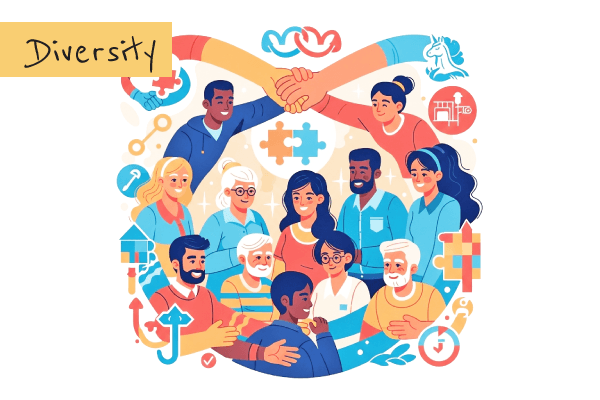
Diversity recognises and values the differences within society.
- Diversity recognises the range of differences within society, including race, ethnicity, gender, age, religion, abilities, and cultural backgrounds.
- It reflects an aspiration for societies to embrace and include people from all different backgrounds.
- The goal is to foster integration, reduce fear, misperceptions, and social isolation.
- Often, “diversity” is used as a collective term in policies and laws aimed at supporting minority and vulnerable groups.
- Ultimately, diversity is about creating societies where everyone feels included, safe, and free from discrimination.
Diversity, as a term, refers to and acknowledges the presence of a wide range of different characteristics, qualities, or identities within a specific group or across the wider society. The policies and their application often aim to embrace variations in race, ethnicity, gender, age, religion, cultural background, abilities, perspectives, and experiences, fostering inclusivity, as well as integrating and enriching the collective community.
In modern times, the availability and ease of global travel have led to more multicultural societies, where minority groups differ in appearance, language, and customs. Many of these immigrants have enriched the societies they call their home by introducing new cultures, foods, and perspectives, fostering tolerance and development. However, integration often involves challenges like fear, racism, and restrictive policies.
During the transition to more integrated societies, many countries implement laws and policies designed to protect the more vulnerable groups amongst society, ensuring fairness in areas such as access to work, healthcare, housing, and legal protections, all with the aim of societies that value and embrace diversity. The ultimate objective is to create societies where all individuals, regardless of background or minority status, are safe, respected, and included.
UNDERSTANDING DIVERSITY
In most societies around the world, there is often one larger or prominent ethnic group that makes up the majority of society. These significant groups are typically descendants of people who settled in that country, region or area in large numbers over the centuries due to invasion, migration, colonisation, geographical isolation, and a range of other socioeconomic factors. With many people throughout time migrating in search of better opportunities and improved conditions, or due to being displaced, escaping conflict and persecution, or simply in the search for safety and prosperity, all these factors have likely shaped the demographic makeup of many modern-day nations.In modern times, the availability and ease of global travel have led to more multicultural societies, where minority groups differ in appearance, language, and customs. Many of these immigrants have enriched the societies they call their home by introducing new cultures, foods, and perspectives, fostering tolerance and development. However, integration often involves challenges like fear, racism, and restrictive policies.
During the transition to more integrated societies, many countries implement laws and policies designed to protect the more vulnerable groups amongst society, ensuring fairness in areas such as access to work, healthcare, housing, and legal protections, all with the aim of societies that value and embrace diversity. The ultimate objective is to create societies where all individuals, regardless of background or minority status, are safe, respected, and included.
Diversity is not about tokenism in a bid to seem inclusive, nor is it about focusing on high-level superficial differences. It is not about excluding anyone within society, including those within the majority or marginalised minorities. Nor is it about applying stereotypes or generalisations, or being a one-time initiative.
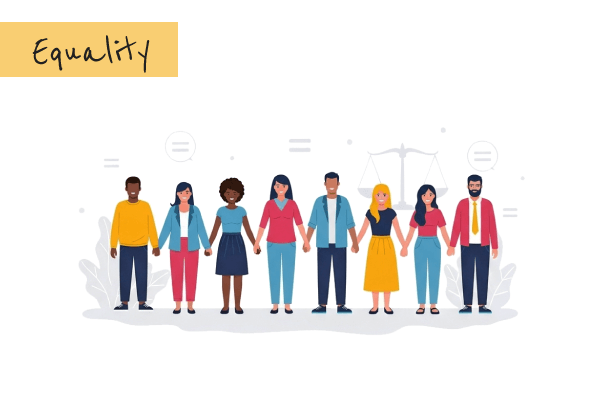
Equality aims to treat everyone the same.
- Equality is about giving everyone the same opportunities, rights, and treatment.
- It focuses on fairness and justice, ensuring that no one is discriminated against because of their differences.
- The goal is to create a society where everyone is treated equally, regardless of background or characteristics.
Equality refers to the state or condition where individuals or groups are given the same opportunities, rights, and treatment, regardless of their differences such as race, gender, age, religion, or background. It emphasises fairness and justice, ensuring that everyone has an equal chance to participate, succeed, and access resources without discrimination or bias.
For example, in the late 19th and early 20th centuries, the women’s suffrage movement took place in many countries around the world. The movement focused on women’s rights, advocating for women to have equal voting rights, access to education, the ability to work, and the right to own assets without needing or seeking permission from a man. The movement led to significant improvements in women’s rights in many countries; however, today, there are still nations that suppress women by denying them equal rights, so the movement continues today.
Equality extends beyond just one movement or group to include other factors, such as beliefs and identities, like the right to follow a faith without persecution or discrimination. Another example of this is the LGBTQIA+ movement. Over the years, the movement has seen many positive steps and progress worldwide, with more community members gaining rights and recognition. However, with over a quarter of the community still living in countries where same-sex relationships are criminalised, and many still facing persecution, restrictions on their fundamental human rights due to how they love or how they identify, the movement continues.
Today, new risks and threats are emerging in some countries, even long-established democratic countries, as more far-right and conservative groups seek to undermine the rights and protections that many have fought hard to achieve; with all this in mind, the movement still has a long way to go. Some do not see the irony and hypocrisy regarding equality, which is about treating everyone the same, regardless of differences. Opposing same-sex marriage, then complaining when they feel they are being discriminated against due to their faith, they do not see the disconnect.
A fair society is one where gender is no longer a legal barrier, where individuals can practice their faith and beliefs (subject to not causing harm to others), where people can love and live as they choose, where the vulnerable are protected, and where education is based on facts, not fear.
UNDERSTANDING EQUALITY
In discussions of diversity, it is important to acknowledge that societies are made up of those within the majority, the largest group with similar characteristics, ethnicities, etc, as well as many smaller minority groups. The diversity within society extends beyond ethnicity, and includes other factors such as gender, beliefs (including religion or interests), identity, sexual orientation, socioeconomic background, and many more. These differences can sometimes lead to segregation or division within society, differences that can cause groups or individuals to be treated differently.For example, in the late 19th and early 20th centuries, the women’s suffrage movement took place in many countries around the world. The movement focused on women’s rights, advocating for women to have equal voting rights, access to education, the ability to work, and the right to own assets without needing or seeking permission from a man. The movement led to significant improvements in women’s rights in many countries; however, today, there are still nations that suppress women by denying them equal rights, so the movement continues today.
Equality extends beyond just one movement or group to include other factors, such as beliefs and identities, like the right to follow a faith without persecution or discrimination. Another example of this is the LGBTQIA+ movement. Over the years, the movement has seen many positive steps and progress worldwide, with more community members gaining rights and recognition. However, with over a quarter of the community still living in countries where same-sex relationships are criminalised, and many still facing persecution, restrictions on their fundamental human rights due to how they love or how they identify, the movement continues.
Today, new risks and threats are emerging in some countries, even long-established democratic countries, as more far-right and conservative groups seek to undermine the rights and protections that many have fought hard to achieve; with all this in mind, the movement still has a long way to go. Some do not see the irony and hypocrisy regarding equality, which is about treating everyone the same, regardless of differences. Opposing same-sex marriage, then complaining when they feel they are being discriminated against due to their faith, they do not see the disconnect.
A fair society is one where gender is no longer a legal barrier, where individuals can practice their faith and beliefs (subject to not causing harm to others), where people can love and live as they choose, where the vulnerable are protected, and where education is based on facts, not fear.
Equality is not about uniformly applying treatment without some consideration of the impact and the needs of all groups affected. It is not about ignoring systemic societal barriers or a one-size-fits-all solution, nor is it about treating all disadvantaged groups the same or neglecting to acknowledge any power imbalances that might exist. In addition, it is not about superficial equal rights or ignoring diversity of needs; instead, understanding that equal treatment will not automatically lead to great fairness without support during the transition.
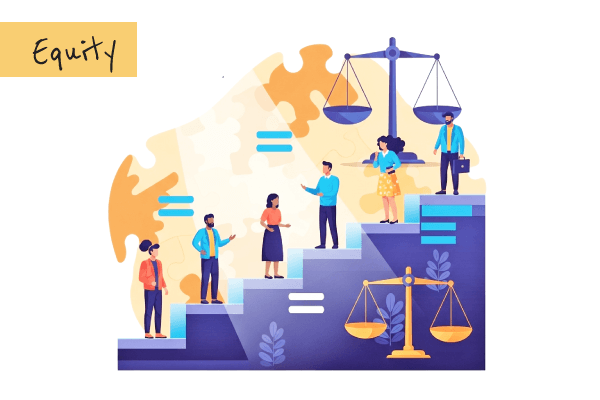
Equity seeks fairness by providing support based on individual needs to give everyone an equal chance to succeed
- Equity focuses on fair treatment that considers individual differences and provides support accordingly.
- It focuses on fairness by addressing the differences based on individual needs and circumstances, especially in the areas of education, employment, healthcare, social services, and access to legal counsel.
- The goal is to create a society where everyone has an equal chance to succeed.
Equity is about creating fairness by recognising and addressing the different needs and circumstances of individuals or groups. Unlike equality, which treats everyone the same, equity involves providing tailored support and resources to ensure that everyone has an equal opportunity to succeed and participate fully in society.
The distinction between the two terms lies more in their application. Equality is best illustrated in the context of rights and protections where individual needs and protections typically do not necessarily need to be considered, such as the right to marry, to receive an education, whereas equity would be more about employment, healthcare and education needs, such as creating working environments for disabled employees, helping children from disadvantaged backgrounds overcome educational barriers and healthcare support for illness that might affect specific minority groups.
Let’s explore equity in action. Imagine you have three athletes of different heights standing on a podium at a presentation ceremony. The goal is for all three individuals to be lined up at the same level and height, which is achieved by adjusting the height of the podium each person stands on. With equality, the podium would be set at the same height for all three, making their height differences obvious. In contrast, equity involves customising the podium:
UNDERSTANDING EQUITY
Equity and equality are closely related concepts, but they each have distinct differences and meanings. Both aim to promote fair opportunities, but they approach this goal differently. Equality means treating everyone the same, providing identical resources and opportunities regardless of individual circumstances. Equity, on the other hand, involves fairness by recognising and addressing individual needs and barriers, ensuring that everyone has an equal chance to succeed. So, simply put, fairness and opportunity based on individual needs, skills and experience, rather than just a blanket equal treatment for all.The distinction between the two terms lies more in their application. Equality is best illustrated in the context of rights and protections where individual needs and protections typically do not necessarily need to be considered, such as the right to marry, to receive an education, whereas equity would be more about employment, healthcare and education needs, such as creating working environments for disabled employees, helping children from disadvantaged backgrounds overcome educational barriers and healthcare support for illness that might affect specific minority groups.
Let’s explore equity in action. Imagine you have three athletes of different heights standing on a podium at a presentation ceremony. The goal is for all three individuals to be lined up at the same level and height, which is achieved by adjusting the height of the podium each person stands on. With equality, the podium would be set at the same height for all three, making their height differences obvious. In contrast, equity involves customising the podium:
- The tallest athlete remains on the original podium height
- The second-tallest athlete’s podium is raised to match the tallest
- The shortest athlete’s podium is raised the most to align with the others
It is important to understand that equity is not about giving specific individuals or groups an advantage or priority. Equity is not about favouritism or creating environments that create an unfair advantage for groups or individuals. It is not about ignoring individual needs, a one-size-fits-all solution or providing equal resources without context. Most importantly, it is not about perpetuating inequality by creating a superficial or token approach to fairness and ignoring diversity and how different aspects of identity intersect and impact individuals’ experiences. Equity is about ensuring fairness by making sure that people with the right skills and experiences, who are best suited for an opportunity, can access it without discrimination based on race, religion, gender, sexual orientation, or gender identity.
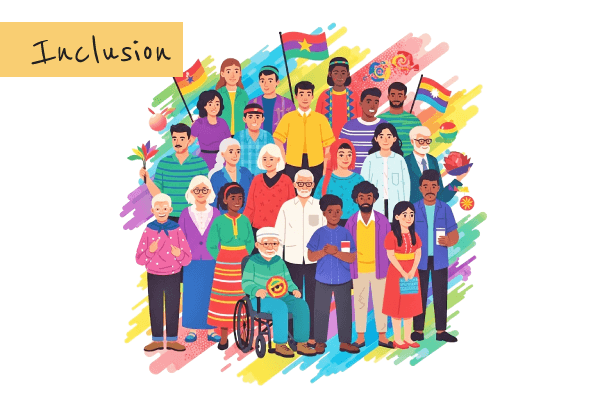
Inclusion is achieved through creating environments where everyone feels valued, respected, and able to participate fully.
- Inclusion is about creating environments where all individuals feel valued, respected, and able to participate fully.
- Environments that welcome diverse perspectives and ensure equal access to opportunities, resources, and decision-making processes for all.
- Enabling individuals to contribute their unique talents and experiences without fear of discrimination or exclusion.
Inclusion is an aspiration and is applied through the implementation of standards and policies that create environments where all individuals feel valued, respected, and able to participate fully, regardless of their background, characteristics, or differences. It involves actively welcoming diverse perspectives and ensuring that everyone has equal access to opportunities, resources, and decision-making processes. Inclusion fosters a sense of belonging and empowerment, enabling individuals to contribute their unique talents and experiences without fear of discrimination or exclusion.
In order to create inclusive environments, it is essential to identify and address systemic inequalities, societal and individual biases, and attitudes that may hinder participation. A positive environment is cultivated by building a sense of community, where diversity and difference are not only acknowledged but celebrated as strengths. Recognising that people, including those from different races, religions, socioeconomic backgrounds, sexual orientations, abilities, and gender identities, bring unique perspectives that enrich the environments they are a part of, leading to more innovative ideas, better problem-solving, and a more equitable and cohesive social fabric.
Inclusive environments are not built by ignoring or overriding existing cultures; instead, they are founded on respecting and enhancing the current cultural landscape while integrating the diverse influences of all individuals. When people feel a genuine sense of belonging, they are confident in seeking opportunities, resources, and being involved in decision-making processes. Barriers to participation are identified and removed, fostering a culture where everyone feels safe to express their authentic selves, share perspectives, and contribute meaningfully—free from discrimination, bias, or exclusion.
Many modern nations are evidence of inclusion, both directly and indirectly. Consider the history of nations, which, through invasions, mass migrations, and evolving societal attitudes, has all shaped their perspectives and communities. These influences are reflected not only in societal behaviours but also in architecture, culture, languages, and many other aspects that contribute to individual and collective identities.
UNDERSTANDING INCLUSION
Inclusion is both an aspiration and an active approach in creating environments, whether in workplaces, schools, communities, or nations as a whole. It is the proactive approach taken to ensure that individuals and groups feel valued, respected, and empowered to participate. It is more than just acceptance or tolerance; it is about actively acknowledging, embracing and celebrating differences such as race, ethnicity, gender, age, ability, sexual orientation, religion, socioeconomic status, and other characteristics.In order to create inclusive environments, it is essential to identify and address systemic inequalities, societal and individual biases, and attitudes that may hinder participation. A positive environment is cultivated by building a sense of community, where diversity and difference are not only acknowledged but celebrated as strengths. Recognising that people, including those from different races, religions, socioeconomic backgrounds, sexual orientations, abilities, and gender identities, bring unique perspectives that enrich the environments they are a part of, leading to more innovative ideas, better problem-solving, and a more equitable and cohesive social fabric.
Inclusive environments are not built by ignoring or overriding existing cultures; instead, they are founded on respecting and enhancing the current cultural landscape while integrating the diverse influences of all individuals. When people feel a genuine sense of belonging, they are confident in seeking opportunities, resources, and being involved in decision-making processes. Barriers to participation are identified and removed, fostering a culture where everyone feels safe to express their authentic selves, share perspectives, and contribute meaningfully—free from discrimination, bias, or exclusion.
Many modern nations are evidence of inclusion, both directly and indirectly. Consider the history of nations, which, through invasions, mass migrations, and evolving societal attitudes, has all shaped their perspectives and communities. These influences are reflected not only in societal behaviours but also in architecture, culture, languages, and many other aspects that contribute to individual and collective identities.
Inclusion is not about tolerating differences, superficial diversity, or ignoring systemic barriers. It is not about hijacking, ignoring the existing cultures and environment or prioritising new groups or individuals. It is ultimately about embracing new influences and evolving environments by combining the old and new, ensuring that all individuals are valued, respected, and able to participate meaningfully.
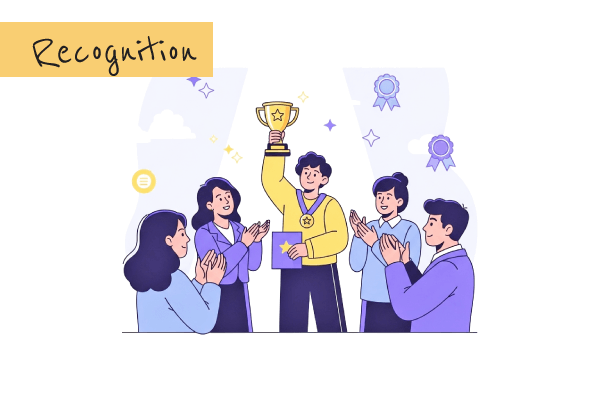
Recognition is about acknowledging, valuing and affirming people’s contributions and identities.
- Recognition refers to the act of acknowledging and valuing an individual’s qualities, achievements, contributions, or identities.
- Recognition is one of the most important words in the context of progress
- It plays a vital role in fostering a sense of worth, belonging, motivation and making individuals feel truly seen and valued
Recognition refers to the act of acknowledging and valuing an individual’s qualities, achievements, contributions, or identities. It plays a vital role in fostering a sense of worth, belonging, and motivation. Recognition involves appreciating the unique backgrounds, perspectives, and experiences that individuals bring. It helps affirm their identities and contributions, which can boost confidence, promote engagement, and reinforce a culture of respect and appreciation.
For example, in countries where same-sex relationships are illegal, individuals who share details about their sexuality risk criminal prosecution. They may face persecution, social isolation, and even threats to their lives in countries with severe penalties. When environments do not allow people to share key aspects of their lives openly, neither the government nor society as a whole recognises the size, scale, or impact of these individuals and their experiences. Although diverse people still exist within society, they are often not acknowledged or recognised by their environments.
Creating environments where people can be themselves without fear of persecution signifies that nations or organisations are acknowledging the diverse realities of all individuals within communities. Recognition means that these groups can be represented, their contributions acknowledged, and they can become integrated into broader society. Importantly, recognition is not limited to collective groups; it also involves individual representation. Think about the multitude of identities and cultures that make up a single country.
Within the LGBTQIA+ community, the terminology has been expanded to reflect the wide variety of identities and experiences. While the letters often serve as umbrella terms for related sexualities and gender identities, the individuals within these groups can have very different challenges, priorities, and needs. For instance, the experiences of someone who identifies as transgender will differ significantly from those of someone who identifies as gay.
UNDERSTANDING RECOGNITION
Recognition is one of the most important words in the context of progress, as it involves acknowledging and valuing individuals’ identities and characteristics. It is crucial because societies that do not allow or encourage visibility, meaning the ability for people to share their race, ethnicity, gender, age, ability, sexual orientation, religion, socioeconomic status, and other attributes, will be unaware of the fabric of their society, resulting in critical issues and challenges being overlooked. Without recognition, these issues remain unaddressed, and meaningful actions are rarely undertaken. As a result, social environments tend to evolve slowly or stagnate altogether. Without recognition, many progress initiatives and aspirations cannot be effectively realised and implemented.For example, in countries where same-sex relationships are illegal, individuals who share details about their sexuality risk criminal prosecution. They may face persecution, social isolation, and even threats to their lives in countries with severe penalties. When environments do not allow people to share key aspects of their lives openly, neither the government nor society as a whole recognises the size, scale, or impact of these individuals and their experiences. Although diverse people still exist within society, they are often not acknowledged or recognised by their environments.
Creating environments where people can be themselves without fear of persecution signifies that nations or organisations are acknowledging the diverse realities of all individuals within communities. Recognition means that these groups can be represented, their contributions acknowledged, and they can become integrated into broader society. Importantly, recognition is not limited to collective groups; it also involves individual representation. Think about the multitude of identities and cultures that make up a single country.
Within the LGBTQIA+ community, the terminology has been expanded to reflect the wide variety of identities and experiences. While the letters often serve as umbrella terms for related sexualities and gender identities, the individuals within these groups can have very different challenges, priorities, and needs. For instance, the experiences of someone who identifies as transgender will differ significantly from those of someone who identifies as gay.
Recognition is not about superficial praise, empty compliments, or generic acknowledgements that lack sincerity or specificity. It is also not about forced or obligatory gestures that do not genuinely reflect someone’s efforts, achievements, or identity. Effective recognition is genuine, specific, and timely. It moves beyond vague praise to highlight particular efforts or qualities, making individuals feel truly seen and valued.
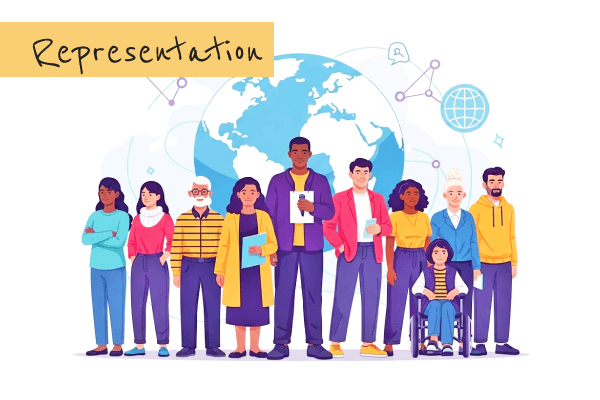
Representation ensures that diverse voices and identities are visible, authentic, and valued in society.
- Representation refers to the way individuals, groups, or ideas are presented, depicted, or included within society, media, institutions, or any context.
- It is comprised of two key aspects: first, visibility, being seen by the wider community; and second, how something is presented, the manner of its portrayal, tone, and underlying message.
- Accurate representations and portrayals help shape societal perceptions, promote empathy, and provide role models for marginalised groups.
Representation refers to the way individuals, groups, or ideas are presented, depicted, or included within society, media, institutions, or within a broader public context. It involves ensuring that diverse voices, experiences, and identities are acknowledged and visible, allowing for a more accurate and reflective representation based on reality, not an outdated stereotype or belief.
Historically, many film industries worldwide produced movies where characters, environments, and storylines were outdated or did not reflect reality. For example, if a modern-day film set in a well-known and popular European city featured only Caucasian actors, with sunny weather during winter, it would not accurately depict reality. Most European cities are ethnically diverse, and during the harshest winter months, the weather is typically cold and often overcast, not sunny and warm.
Imagine living in a city like the one portrayed in such a film, where you belong to an ethnicity that makes up 20% of the city’s population. Not seeing people like you represented means the film not only fails to reflect reality but also perpetuates a white-washed and misrepresentative portrayal of the city.
While visibility is crucial, how people and groups are represented matters just as much. If characters are based on outdated stereotypes or biased perspectives, it can negatively influence perceptions and reinforce prejudices. For example, portraying all gay men as camp and hedonistic partygoers does not reflect reality. Gay men, like any other group, come from diverse backgrounds, have families, and exhibit a wide range of characteristics and behaviours. Accurate portrayals help shape societal perceptions, promote empathy, and provide role models for marginalised groups, demonstrating an understanding of the nuances within society.
Representation is vital for ensuring that the identities and experiences of diverse groups are visible and acknowledged within the broader society. It involves portraying individuals and groups in ways that are authentic and respectful. It also means giving marginalised or underrepresented voices a seat at the table. When done well, representation can enable people to see themselves reflected positively, fostering a sense of belonging and confidence.
UNDERSTANDING REPRESENTATION
When discussing representation, it comprises two key aspects: first, visibility, being seen by the wider community; and second, how something is presented, the manner of its portrayal, tone, and underlying message. Societies that do not foster environments promoting true and accurate representation contribute to the marginalisation of these groups within their communities and perpetuate discrimination, outdated stereotypes, and biases. In reality, most modern communities are comprised of diverse individuals from various races, ethnicities, genders, ages, abilities, sexual orientations, religions, socioeconomic backgrounds, and other attributes.Historically, many film industries worldwide produced movies where characters, environments, and storylines were outdated or did not reflect reality. For example, if a modern-day film set in a well-known and popular European city featured only Caucasian actors, with sunny weather during winter, it would not accurately depict reality. Most European cities are ethnically diverse, and during the harshest winter months, the weather is typically cold and often overcast, not sunny and warm.
Imagine living in a city like the one portrayed in such a film, where you belong to an ethnicity that makes up 20% of the city’s population. Not seeing people like you represented means the film not only fails to reflect reality but also perpetuates a white-washed and misrepresentative portrayal of the city.
While visibility is crucial, how people and groups are represented matters just as much. If characters are based on outdated stereotypes or biased perspectives, it can negatively influence perceptions and reinforce prejudices. For example, portraying all gay men as camp and hedonistic partygoers does not reflect reality. Gay men, like any other group, come from diverse backgrounds, have families, and exhibit a wide range of characteristics and behaviours. Accurate portrayals help shape societal perceptions, promote empathy, and provide role models for marginalised groups, demonstrating an understanding of the nuances within society.
Representation is vital for ensuring that the identities and experiences of diverse groups are visible and acknowledged within the broader society. It involves portraying individuals and groups in ways that are authentic and respectful. It also means giving marginalised or underrepresented voices a seat at the table. When done well, representation can enable people to see themselves reflected positively, fostering a sense of belonging and confidence.
Importantly, representation is not about superficial appearances, tokenism, or stereotypes that reduce individuals or groups to clichés. It is also not about marginalising or misrepresenting people to fit particular narratives, nor does it mean including someone superficially without genuine respect or inclusion. Accurate and true representation is about accurately reflecting the diversity of the environments and communities around us.
Progressive terms are often aspirational and reflect the goal or objective for a fairer society. Although the implementation of progressive initiatives can often fall short, the intention behind them is positive and well-meaning: to ensure that all within society feel seen, included, and have access to services, opportunities, and integration within their respective societies.
Many of these terms have been hijacked and misrepresented to become something that they are not. Politicised as tools to spark fear within the majority, creating a sense of injustice and segregation between society and the many minority groups that make up the communities they live within. Often perpetuating the misconception that these initiatives are taking jobs and opportunities away from regular citizens or creating unfair advantage for marginalised groups. The reality behind all these false narratives does not reflect the truth.
All have access to employment and opportunities. If there are limited opportunities within any given country, the solution is not to restrict marginalised groups from gaining employment; instead, it is to ask those in power why so few jobs or opportunities exist in the first place. Often, the focus is shifted to the effect, not the cause, which can frequently be attributed to mismanagement and a lack of government oversight in creating a prosperous environment.
Many of these terms are shortened to acronyms like DEI, as it is easier to ridicule and polarise people against three letters, rather than for what they really stand for, fairness. In the same way, woke is often used to describe many of these initiatives and is frequently positioned as more socialist and linked to those with left-leaning political beliefs. Using the same logic, you could argue that those with more right-leaning principles would be considered Trad, or trying to take things back to a time they perceive to be better for them.
In reality, there is no going back, or even halting or stopping progress. Though many may believe the worse when it comes to progressive initiatives, it ultimately is about treating people fairly, not just some, but everyone in society.
Stay safe, and until the next time.
Many of these terms have been hijacked and misrepresented to become something that they are not. Politicised as tools to spark fear within the majority, creating a sense of injustice and segregation between society and the many minority groups that make up the communities they live within. Often perpetuating the misconception that these initiatives are taking jobs and opportunities away from regular citizens or creating unfair advantage for marginalised groups. The reality behind all these false narratives does not reflect the truth.
All have access to employment and opportunities. If there are limited opportunities within any given country, the solution is not to restrict marginalised groups from gaining employment; instead, it is to ask those in power why so few jobs or opportunities exist in the first place. Often, the focus is shifted to the effect, not the cause, which can frequently be attributed to mismanagement and a lack of government oversight in creating a prosperous environment.
Many of these terms are shortened to acronyms like DEI, as it is easier to ridicule and polarise people against three letters, rather than for what they really stand for, fairness. In the same way, woke is often used to describe many of these initiatives and is frequently positioned as more socialist and linked to those with left-leaning political beliefs. Using the same logic, you could argue that those with more right-leaning principles would be considered Trad, or trying to take things back to a time they perceive to be better for them.
In reality, there is no going back, or even halting or stopping progress. Though many may believe the worse when it comes to progressive initiatives, it ultimately is about treating people fairly, not just some, but everyone in society.
Stay safe, and until the next time.
Learn more about the exceptional LGBTQIA+ community, discover the community’s history, the ongoing movement for equality, the size of the community and how much it contributes to the world economy, frequently asked questions and much more.

Acceptance and coming to terms with a part of what makes you can be challenging for many people. The Gayther pride in series is about celebrating all things relating to sexualities, gender identities and special groups. Showcasing the exceptional people, interesting facts and ways to connect with those unique communities

Discover all of the topical articles and the latest community news. Whether you are looking for news stories, articles reflecting topical subjects written by people from the community or the latest trends. Gayther is here to provide you with the information you need when you need it.



IMPORTANT DISCLAIMER: All published articles have been written by members of the general public. Many will likely not be journalists nor be affiliated with any professional bodies associated with members of the media. The articles will likely be based on the authors’ own opinions, views, and experiences. Gayther does not endorse or accept any responsibility or liability regarding any materials within the news and media pages. This page may contain external links to third party websites; Gayther provides these links for your convenience and does not endorse, warrant or recommend any particular products or services. By clicking on any external links, you will leave Gayther and be taken to the third-party website, which you do so at your own risk and by accessing the site, you will be required to comply with the external third party’s terms and conditions of use and privacy policies
Discover all of the topical articles written by people from across the community and friends, all sharing their stories, opinions and experiences